
Reviewed · LIVERPOOL TOURS
Liverpool: Heritage, History & Culture Guided Walking Tour
Liverpool’s story is bigger than the Beatles, though the Beatles are never far away. This two-hour walk links the city’s medieval beginnings, maritime power, role in the slave trade, grand civic buildings, and music legacy in one compact route. The honest treatment of Liverpool’s past gives the tour more weight than a simple photo walk.
I like the way the route joins major sights that can otherwise feel scattered, especially the Royal Albert Dock and Three Graces. I also like the guides’ personal approach. Mike, Pam, Allan, Carl, Karl, Colleen, and Alan are among the guides praised for clear storytelling, humor, and patience with questions.
The main consideration is pace and footing. You cover busy streets, cobbles, and other uneven surfaces with a group, so comfortable shoes matter. The booking information calls the route wheelchair accessible, yet also says it is not suitable for wheelchair users or people with mobility impairments. Ask the provider to confirm current access before paying.
Key points to know before you book
- Liverpool’s difficult past is included: You hear about maritime trade and the city’s role in the slave trade, not just its prettier buildings.
- The route covers major landmarks efficiently: The Bluecoat, Liverpool One, Royal Albert Dock, Beatles Statue, Three Graces, Cavern Quarter, Town Hall area, and Eleanor Rigby Statue fit into two hours.
- The guides are the heart of the walk: Mike, Mike D, Pam, Allan, Carl, Karl, Colleen, and Alan are noted for warmth, humor, clear voices, and detailed local stories.
- The Beatles appear in context: You pass the Cavern Club and the Beatles Statue rather than spending the whole tour on music alone.
- You get a useful first look at Liverpool: It works especially well on a first visit, helping you choose which museums, docks, and music sites deserve more time.
- Plan for outdoor conditions: Bring water, a camera, and sturdy shoes. Food and drinks are not included.
Starting at the Bluecoat on School Lane
The walk begins outside the front gates of the Bluecoat Chambers at 8 School Lane, Liverpool L1 3BX. Look for the black metal railings at the main entrance and the Castle Fine Art gallery-shop opposite. This is the Bluecoat Chambers, not the Blue Coat School.
The meeting point is central, but a precise location matters in a busy city. The supplied three-word location is Soccer Trial Cuts, which can help if your phone map sends you toward the wrong part of the building. The tour leaves from outside the gates, so do not wait inside.
If you arrive early, the Bluecoat Chambers is open from 10 a.m. Tuesday through Saturday and has a café and toilets. The tour itself is outdoors, so these facilities are useful before setting off, especially if your start time follows a morning train arrival.
The opening section gives you a quick orientation to Liverpool’s development, from the time of King John to the present day. It is not a museum lecture, and two hours cannot cover every period in detail. Instead, your guide uses buildings, squares, and street corners to show how the city changed.
That approach suits Liverpool. The city’s past is easy to miss if you only photograph the waterfront. A good guide connects the old street plan, commercial growth, civic pride, maritime trade, and modern redevelopment into a story you can follow while walking.
More History Tours in Liverpool
- Liverpool: Haunted History Guided City Tour
★ 4.9 · 404 reviews - Liverpool: A Walk Through Time: Full History Walking Tour
★ 4.8 · 184 reviews - Liverpool: St James’ Cemetery Historical Ghost Tour
★ 4.9 · 169 reviews
Liverpool One and the changing city center
Liverpool One provides an early look at the modern city. The stop is short, about 10 minutes, but it helps you see how shopping, public space, and older streets now sit together in the center.
Your guide also points out architecture from different periods. The tour includes historic buildings and newer additions, so you get more than a parade of old façades. This is useful if you want to understand how Liverpool functions today, rather than treating the center as a preserved stage set.
The guide’s commentary is important here because the area itself can feel familiar to anyone who has visited a large British shopping district. The value comes from hearing what stood here before, how the center developed, and how the newer buildings relate to Liverpool’s older core.
The walk then moves toward Derby Square. Here you hear about Liverpool Castle, which once occupied the site, and the later monument to Queen Victoria. The square shows how power and public memory changed over time: a fortified medieval presence gave way to a formal civic setting.
Derby Square and Liverpool’s maritime beginnings
A large water fountain marks the site of Liverpool’s first dry dock. This is one of the more useful stops because it links an ordinary-looking city space to the port that helped shape Liverpool’s fortunes.
Your guide explains the city’s maritime development and the trade networks connected to it. Crucially, this includes Liverpool’s role in the slave trade. That subject is not treated as a footnote to the city’s success. It forms part of the wider explanation of how wealth, shipping, and commerce affected Liverpool.
This is one reason I would choose this walk over a tour focused only on grand buildings and the Beatles. You get a more balanced introduction, with achievements and uncomfortable parts placed in the same story. The guide can also answer questions as they arise, which several participants found especially useful.
You may also see the oversized LIVERPOOL sign, whose colors change with seasons or events. It is an easy photo stop and a lighter moment after the more serious port history. Bring a camera, but keep the sign in proportion. It is a fun city-center marker, not a major historical sight.
Thirty minutes around the Royal Albert Dock
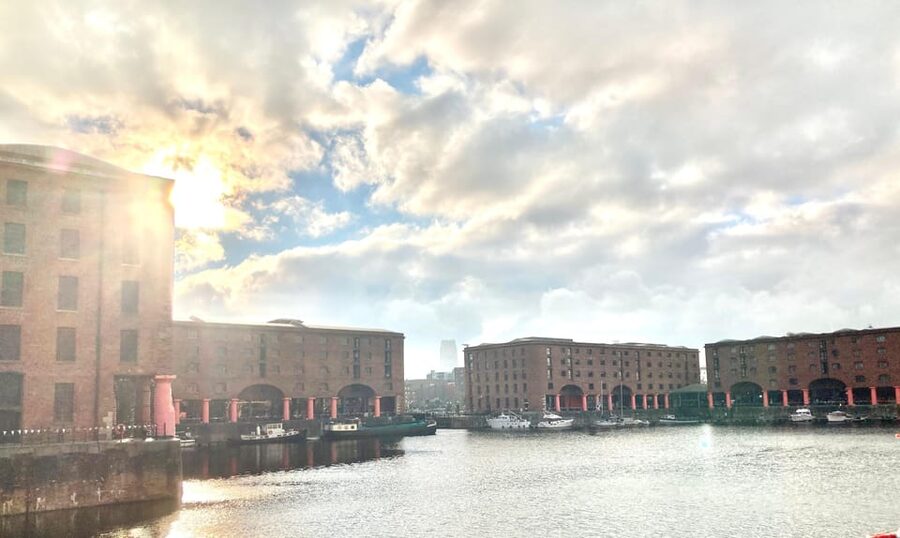
The Royal Albert Dock receives the longest scheduled stop, about 30 minutes. That is sensible. The dock combines industrial design, waterfront views, restored warehouses, and a strong connection to Liverpool’s port story.
Here you learn how the docks helped the city grow and how maritime trade shaped everyday life. The setting makes the explanation easier to grasp because you are standing among the structures built for that work. You are not just hearing about cargo, ships, and commercial power in an abstract room.
The Titanic story also enters the tour at the waterfront. Liverpool’s links with the ship are part of the city’s maritime memory, even though the Titanic did not sail from Liverpool. Expect this to be one thread in a broader port story, not a visit to a Titanic museum.
The dock is also a good place to pause for photographs. The route includes a photo stop, but this is still a walking tour, not a long free period for independent sightseeing. If you want to visit museums or restaurants around the dock, save them for after the tour.
One practical point: waterfront paving can include uneven surfaces, and the group continues on foot. If you use a stroller, take care over cobbles and crowded areas. The tour information says locations are accessible for strollers and wheelchairs, but the separate warning about mobility limitations deserves attention before booking.
More Walking Tours in Liverpool
- Liverpool: Beatles Highlights Walking Tour
★ 4.8 · 274 reviews - Liverpool: The Beatles and Cavern Quarter Walking Tour
★ 4.7 · 133 reviews - Liverpool: Guided City Walking Tour
★ 4.9 · 119 reviews - Liverpool: The Beatles and Waterfront Guided Walking Tour
★ 4.7 · 51 reviews
The Beatles Statue and the Three Graces
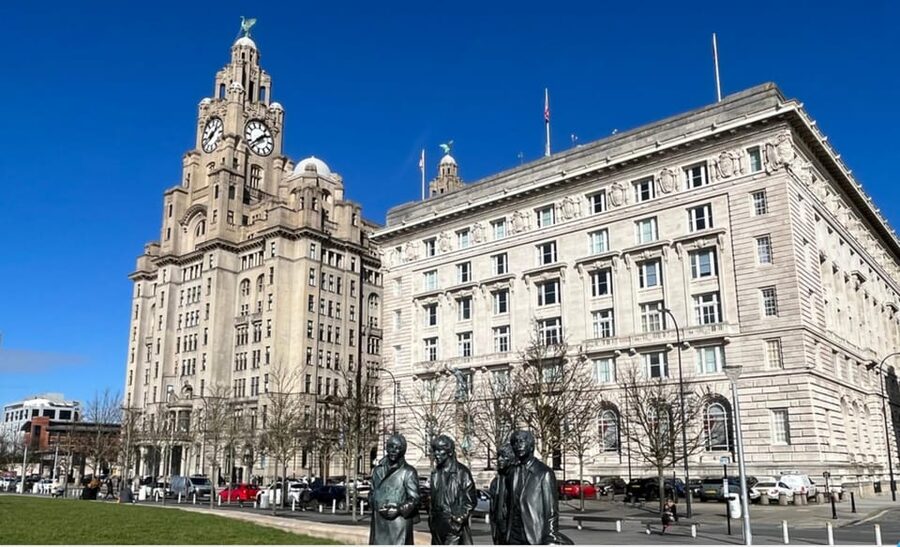
From the dock area, the route reaches the Beatles Statue, sculpted by Andrew Edwards. You have about 10 minutes for the stop, enough for a photograph with the Fab Four and a short explanation of their place in Liverpool’s public identity.
This is not a substitute for a dedicated Beatles tour. Instead, it gives you a useful marker within a wider city story. You see how music sits alongside shipping, commerce, civic buildings, and street culture.
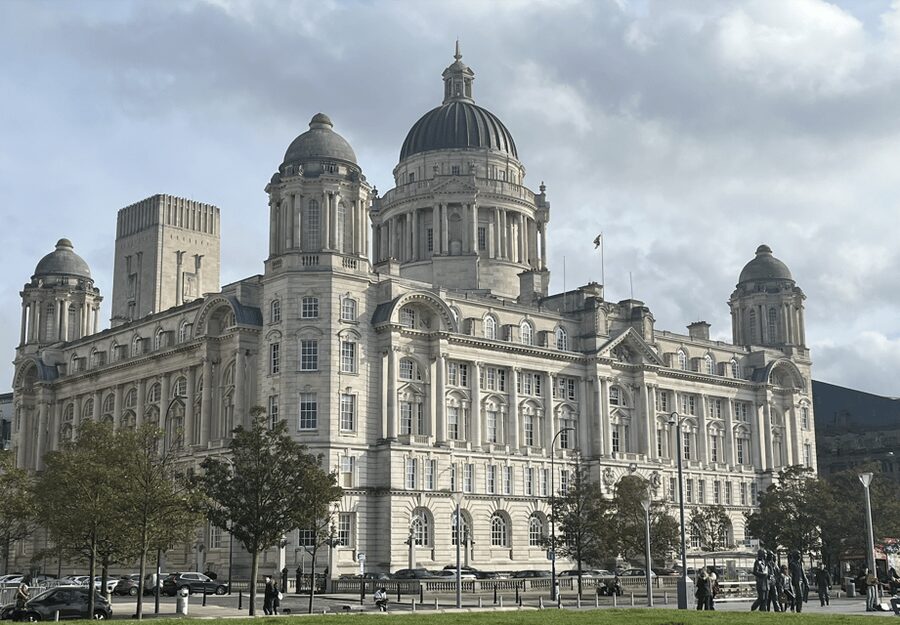
The Three Graces are among Liverpool’s most impressive architectural sights. They are the Grade II listed Cunard Building, the Port of Liverpool Building, and the Liver Building. Together they frame the waterfront and express the confidence of a city whose fortunes were once tied closely to global shipping.
Your guide explains the history and heritage of each building, giving you details to watch for as you look up at the façades. The stop lasts about 15 minutes, so you get a clear introduction and photographs without turning the walk into a long architecture seminar.
The Liver Building is the most instantly recognizable of the three, but it is better understood as part of the group. The Cunard and Port of Liverpool buildings complete the waterfront composition. This is a good example of why a guide helps: a quick glance becomes a lesson in how commerce, shipping, and civic image worked together.
Exchange Flags and the Town Hall story
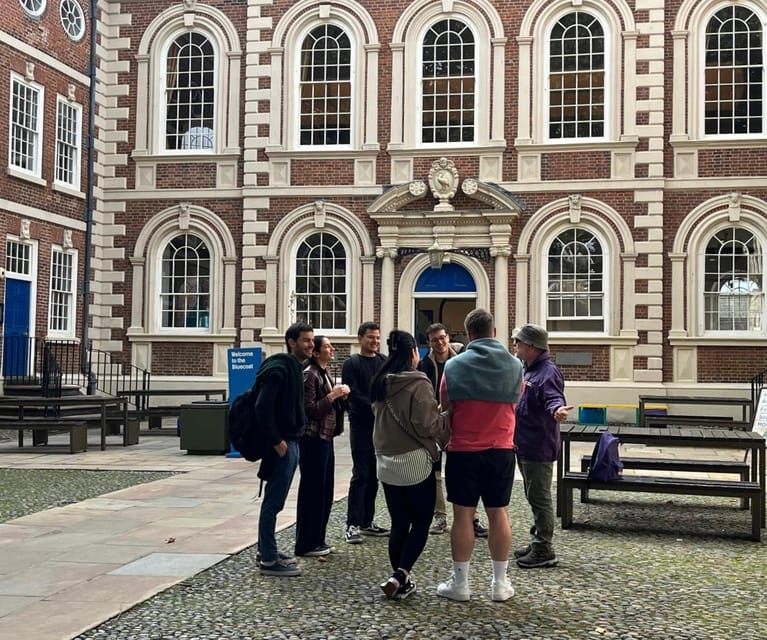
Exchange Flags adds another layer of central Liverpool. It is a Grade II listed courtyard facing the Town Hall, with buildings arranged around a formal open space.
The setting may appeal to you if you enjoy architecture that is less famous than the main postcard sights. The courtyard gives the guide room to explain how business, government, and public life occupied the same central district.
The route then takes you toward the current Town Hall, a Grade I listed building recognized as one of England’s finest surviving 18th-century town halls. Your guide also discusses its predecessors, dating back to the 1500s.
That detail helps place the present building in a much longer civic story. Liverpool’s government did not begin with the building you see today. The succession of town halls reflects the city’s growth and changing ambitions.
The tour does not appear to include an interior visit to the Town Hall, so manage expectations. You are learning about the building from the street and seeing its setting. If you want to explore interiors, ask the guide what can be visited separately after the walk.
Mathew Street and the Cavern Quarter
Mathew Street shifts the mood. It is one of Liverpool’s best-known music streets and is closely tied to the Cavern Club and the Beatles. The scheduled stop in the Cavern Quarter lasts about 20 minutes, giving the music section more room than the brief Beatles Statue visit.
You walk in the footsteps of many musical figures, but the guide also places the street within the city rather than presenting it as a theme park. Expect stories about the Cavern Club, the Beatles, and the artists associated with Liverpool’s music culture.
The street can be busy, and groups need to stay together. That is part of the atmosphere, but it can make listening harder than in a quiet square. A guide with a strong voice helps. Several guides, particularly Mike and Mike D, were singled out for speaking clearly and keeping groups engaged.
If you are a serious Beatles fan, use this stop as a starting point. The tour gives you context and orientation, while a separate Cavern visit or music-focused experience would allow more time inside the club and surrounding venues. If you are only mildly interested in the band, the stop is short enough not to take over the day.
Finishing near Eleanor Rigby
The walk ends at the Eleanor Rigby Statue. This is a fitting Beatles-related finish because it keeps the music thread present without making it the only subject of the tour.
The end point also leaves you in a useful central area for continuing on foot. You can return to sights that caught your attention, look for a café, or continue exploring the city center. No food or drink is included, so plan your own break after the walk.
Because the itinerary moves through several districts, you should not expect to return to the Bluecoat at the end. Keep any onward plans flexible, especially if you need to meet a train or join another timed activity.
How the guides shape the experience
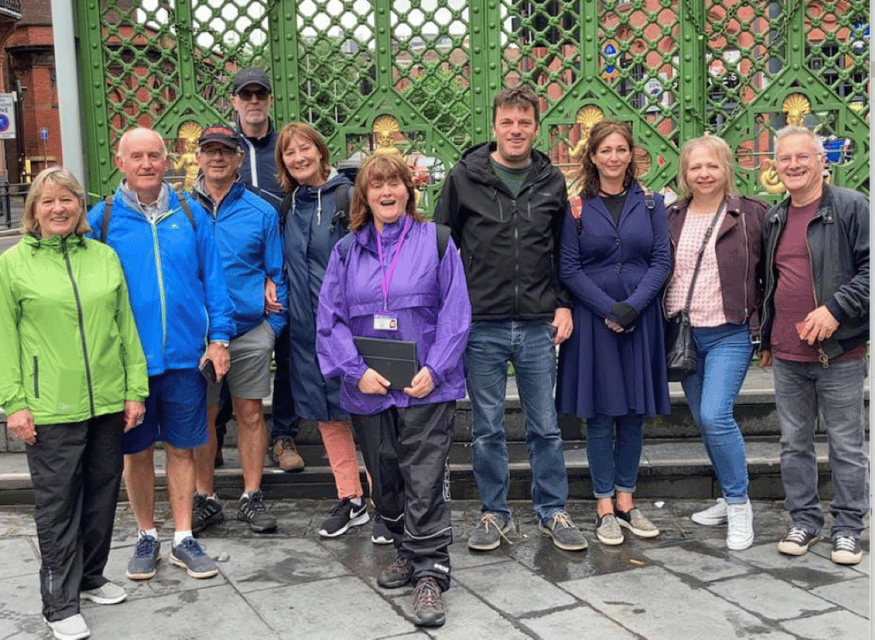
The provider uses local English-speaking guides, and the personality of the individual guide matters here. The guide names connected with this walk include Mike, Mike D, Pam, Allan, Carl, Karl, Colleen, and Alan.
The strongest pattern is not a single scripted presentation. It is the guides’ ability to mix facts, personal stories, humor, and answers to questions. Mike D is described as witty and enthusiastic, Pam as balanced and attentive, and Allan as friendly and professional. Carl is noted for warmth and patience, while Karl brings strong affection for his city and plenty of anecdotes.
That variety can be a benefit. You are hearing from someone who lives with Liverpool’s story rather than following a silent audio guide. It can also mean the tone differs from one departure to another. If you want a particular guide, the supplied information does not promise guide selection, so book for the route and local-led format rather than a named individual.
A useful detail from the feedback is that guides sometimes spend extra time with small groups. One person described having an easy conversation as the only participant, and another said the guide ran longer than planned. Do not count on an extended tour, but it suggests that questions are welcome when time and group size allow.
Price, pace, and practical value
At $31 per person, this is a reasonable price for a two-hour introduction to central Liverpool. You are paying for a local guide who connects about ten major stops, not for entry to attractions, food, or transport.
The value is strongest on a first visit. In two hours, you see enough of the center and waterfront to decide where to spend the rest of your day. That can save time and prevent you from wandering between the docks, Town Hall, and Cavern Quarter without understanding how they connect.
The price is less compelling if you already know central Liverpool well or want long visits inside buildings. This tour is about street-level explanation and orientation. It does not replace the museums, the Cavern Club, or a detailed Beatles experience.
The tour lasts two hours, with times varying by availability. Wear shoes suitable for a steady city walk and cobbles. Bring water and a camera. Well-behaved dogs are allowed, but busy streets and group walking may not suit every dog.
The booking terms add flexibility: you can cancel up to 24 hours before the start for a full refund, and you can reserve now while paying later. That is useful if your Liverpool plans depend on train times or changing weather.
Who should book this Liverpool walking tour?
I would recommend it to first-time visitors, couples, solo visitors, families with older children, and anyone who wants Liverpool’s port, civic, and music stories in one route.
It is especially useful if you want more than Beatles trivia. The discussion of the slave trade, the dry dock, the Titanic connection, civic buildings, and the city’s development gives you a fuller picture of Liverpool.
You may prefer another format if you dislike group walks, need frequent rests, want interior visits, or have serious mobility limitations. The route passes through busy areas and uneven surfaces. The conflicting access notes mean you should contact Liverpool Famous Walking Tours, also known as Purple Tours, before booking if wheelchair access is essential.
Should you book it?
Book this walk if you want a lively, local introduction to Liverpool before exploring on your own. The best parts are the links between the waterfront, the city’s difficult commercial past, its grand buildings, and the Beatles quarter.
Skip it if you want a specialist Beatles tour or a slow architecture tour with indoor access. At $31, it offers good value for orientation, stories, and practical sightseeing, especially when a guide such as Mike, Pam, Allan, Carl, or one of the other local leaders turns a short route into a readable story of the city.
FAQ
How long does the Liverpool Heritage, History & Culture Guided Walking Tour last?
The tour lasts two hours.
Where does the tour start?
It starts outside the main front gates of Bluecoat Chambers, 8 School Lane, Liverpool L1 3BX. Look for the black metal railings and the Castle Fine Art gallery-shop opposite.
Where does the tour finish?
It finishes at the Eleanor Rigby Statue.
What language is the tour in?
The live guided tour is in English.
What sights are included?
The route includes Liverpool One, Royal Albert Dock, the Beatles Statue, the Three Graces, Exchange Flags, the Cavern Quarter and Cavern Club area, the Town Hall area, and the Eleanor Rigby Statue.
Does the tour visit the Cavern Club?
The route passes through Mathew Street and the Cavern Quarter, where you hear about the Cavern Club and Liverpool’s music history. The supplied details do not say that entry to the club is included.
Are food and drinks included?
No. Food and drinks are not included.
What should I bring?
Bring comfortable shoes, water, and a camera.
Are dogs allowed?
Well-behaved dogs are welcome, although the route includes busy areas and group walking.
Is the tour wheelchair accessible?
The activity information says locations are accessible for strollers and wheelchairs, but it also says the tour is not suitable for wheelchair users or people with mobility impairments and warns about cobbles and uneven surfaces. Contact the provider to confirm current access before booking.
Can I cancel the booking?
You can cancel up to 24 hours in advance for a full refund. You can also reserve now and pay later.
New listings around Liverpool
- THE HANGOVER BRUNCH | Benidorm Bingo & Drag Queens★ 4.5 · 15 reviews
- Liverpool: The Beatles Tour on Electric Pedal-Assist Ebikes★ 5.0 · 17 reviews
- Liverpool: Alcotraz Immersive Prison Cocktail Experience★ 4.8 · 20 reviews
- From Liverpool: Full-Day Yorkshire Sightseeing Adventure★ 4.4 · 21 reviews
- Liverpool: FunnyBoyz Benidorm Bingo Cabaret Show★ 4.2 · 25 reviews
- Liverpool: FunnyBoyz Benidorm Bingo Bottomless Brunch★ 4.1 · 27 reviews
- From Liverpool: North Wales Sightseeing Tour Shore Excursion★ 4.3 · 34 reviews
- Liverpool: Theatrical History Tour and The Dead House★ 4.9 · 37 reviews
Liverpool Tours, compared.
Liverpool Football Club Museum and Stadium Tour
Read our review →
City & Beatles Tour with Live Guide & Live Music
Read our review →
Browse the lists this tour appears in