Reviewed · LONDON TOURS
Burnings, Butchery & Black Death: London’s Bloody Past
London’s darkest stories are concentrated around Smithfield, where animal slaughter, public executions, plague burials, prisons, churches, and Dickensian poverty all occupied a surprisingly small part of the city. This two-hour walk turns those grim facts into a clear story rather than a string of spooky tales.
I like the route for two reasons: it links famous names such as William Wallace and Charles Dickens to real streets, and its small group limit of 15 should make it easier to hear the guide and ask questions. The main drawback is the subject matter. Medieval executions and the Black Death are described frankly, so this is not a gentle family outing, and children under 13 cannot join.
Key points about London’s bloody past
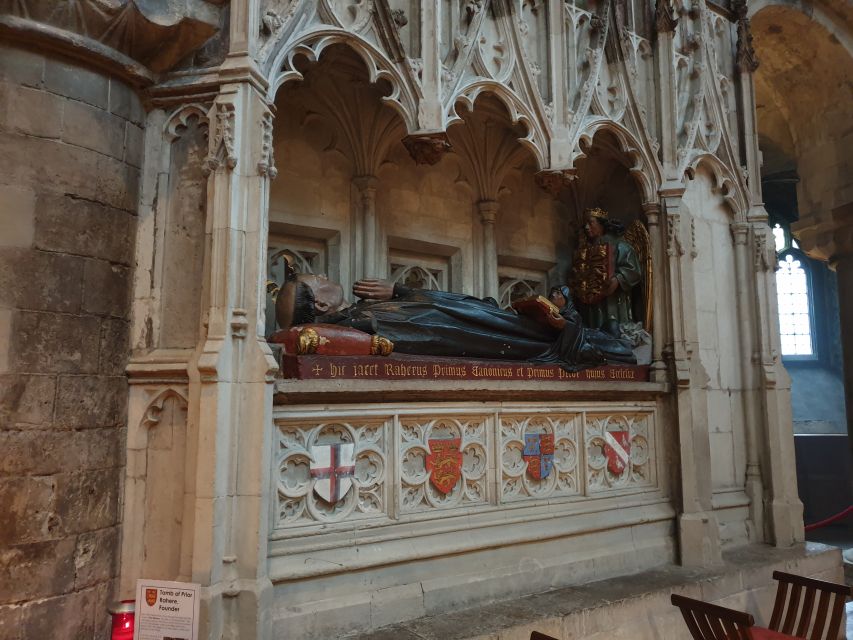
- Smithfield’s double history: The district served for centuries as both a livestock market and a place of human execution.
- Black Death burials: You’ll hear how London dealt with tens of thousands of victims in the 14th century.
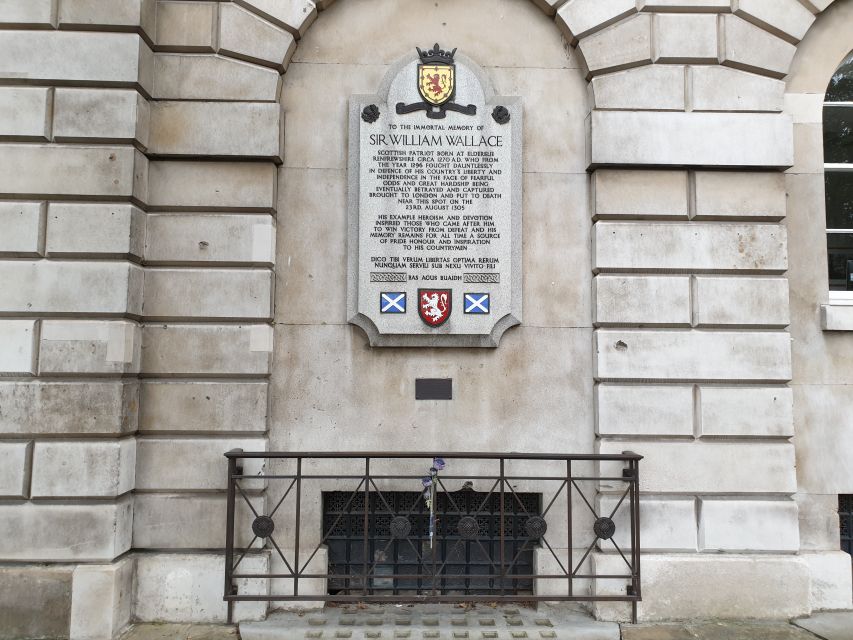
- William Wallace remembered: The route includes the memorial to the Scottish hero, with attention to the grim reality of his execution.
- Dickens and the slums: Cloth Fair and nearby streets help explain the bleak London setting behind Oliver Twist.
- Historic churches included: St Bartholomew the Great and other churches may be entered when no service is taking place.
- A compact central London walk: The tour covers about two miles, beginning at Barbican Station and ending near Farringdon at Ely Place.
Why Smithfield makes such a powerful starting point
This tour works because it does not treat London’s past as a neat parade of kings and grand buildings. It takes you into the less polished story of the city, where death, disease, poverty, religion, food, and punishment were part of daily life.
Smithfield is the natural center of that story. For centuries, animals were brought here for slaughter, while human beings could be executed nearby. That combination gives the area its unsettling character. You are not simply hearing about one violent event. You are tracing how London used the same urban space for trade, punishment, burial, worship, and ordinary housing.
The guide also connects the district to well-known figures. You will hear about kings, body snatchers, Charles Dickens, an 18th-century ghost, and William Wallace, also known as Braveheart. The Wallace story is likely to be one of the tour’s memorable moments, especially because the presentation separates popular film imagery from the harsh facts of his execution.
Guide Tom has led the walk with a mix of historical fact, myth, and humor. That balance matters here. A tour made only of gruesome detail could become tiring or crude, while a lecture without humor would make two hours feel heavy. Tom’s approach, based on the available comments about his tours, also leaves room for questions and adjusts to the group.
A handful of other London outings to weigh up
- From London: Harry Potter Warner Bros Studio Tour
★ 4.7 · 26,588 reviews - London: Westminster to Greenwich River Thames Cruise
★ 4.5 · 22,836 reviews - Magical London: Harry Potter Guided Walking Tour
★ 4.7 · 22,044 reviews
From Barbican Station to Charterhouse Square
Meet just outside the Barbican Station exit on Aldersgate Street. Look for the guide holding an Historic London Tours sign. This is a useful meeting point because it is easy to reach by public transport, though you should allow a little time to find the correct station exit in the busy Barbican area.
The walk begins near Charterhouse Square. Its short stop helps set up the wider story of medieval and later London. You can expect the guide to explain how the district changed over time and how institutions, religious sites, markets, and poor housing came to sit close together.
The first stretch is not a museum visit with objects behind glass. It is a street-level history lesson. You are looking at the actual spaces where the city developed, which makes the route more involving than simply reading dates from a plaque.
The walk covers about two miles in total. That is manageable for most people, but it is still a walking tour, with repeated stops and time on city pavements. Comfortable shoes are sensible. One useful detail from the tour feedback is that Tom was attentive to older participants and helpful with elderly parents, so the pace may suit mixed-age adult groups, within the age restriction.
Smithfield Market and the city’s places of death
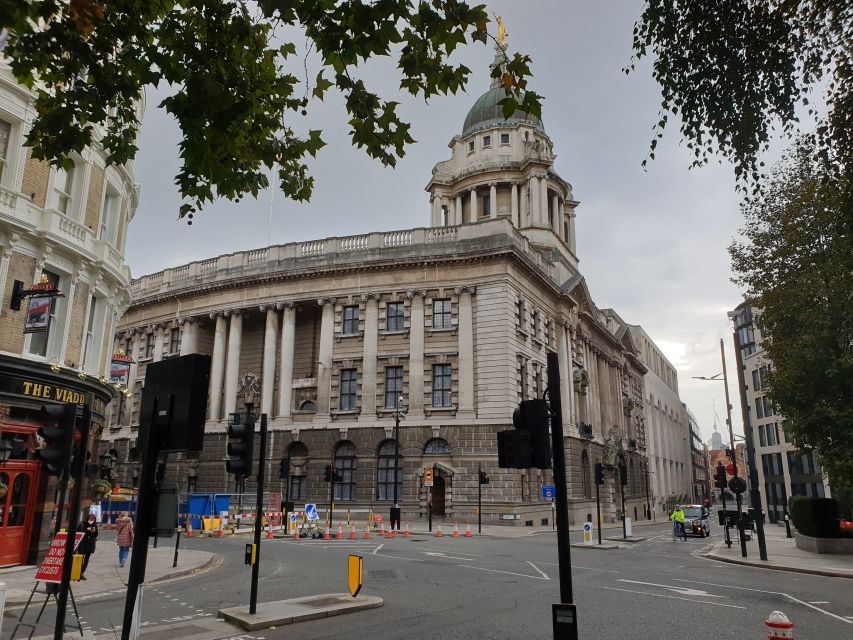
Smithfield Market is the emotional center of the walk. The district’s long connection with animal slaughter gives the tour its title, but the human history is just as important. Here, you will hear about public punishment, executions, and the treatment of bodies during the Black Death.
The plague section is likely to be among the most useful parts for anyone trying to understand medieval London. The story is not simply that disease arrived and people died. The tour explains what happened to the tens of thousands of corpses and how the city tried to manage a crisis on an enormous scale.
That practical angle is valuable. It shows the limits of a medieval city faced with mass death, rather than presenting the Black Death as a distant statistic. The details are grim, but they explain why burial grounds, religious institutions, and urban planning mattered so much.
Smithfield also introduces the methods of medieval execution. Expect a frank account of how punishment worked and why public executions were staged in visible places. This material will appeal to anyone interested in crime and punishment, but it may be too intense for people who prefer lighter London sightseeing.
The modern market area adds another layer. The setting is not frozen in the Middle Ages, and that contrast is part of the point. You are asked to picture earlier uses of a working part of London while standing in a district that continued to serve the city’s food trade.
St John’s Gate and the religious side of the story
The stop at St John’s Gate broadens the tour beyond bloodshed. London’s religious orders, hospitals, and churches were closely tied to care, power, burial, and public life. The gate provides a reminder that the district was shaped by religious institutions as much as by markets and executions.
The guide’s role is especially important here. A site such as St John’s Gate can be easy to pass without much notice, but its position along this route lets you connect it to the surrounding institutions. Instead of viewing each building in isolation, you begin to see how a compact medieval district functioned.
The tour includes entry to churches when no service is taking place. That condition matters. Church access is not guaranteed, so you should think of the interiors as a possible bonus rather than the main reason to book. If you do enter, the change from noisy streets to an old church interior should provide a welcome pause during a subject-heavy walk.
Elsewhere in London, a change of pace:
- London: Madame Tussauds London
★ 4.6 · 20,915 reviews - London: Warner Bros. Studio Tour with Transfers
★ 4.7 · 17,586 reviews - London: Tower Bridge Entry Ticket
★ 4.7 · 15,560 reviews - London: St Paul’s Cathedral Entry Ticket
★ 4.7 · 9,813 reviews
Cloth Fair and Dickens’s London
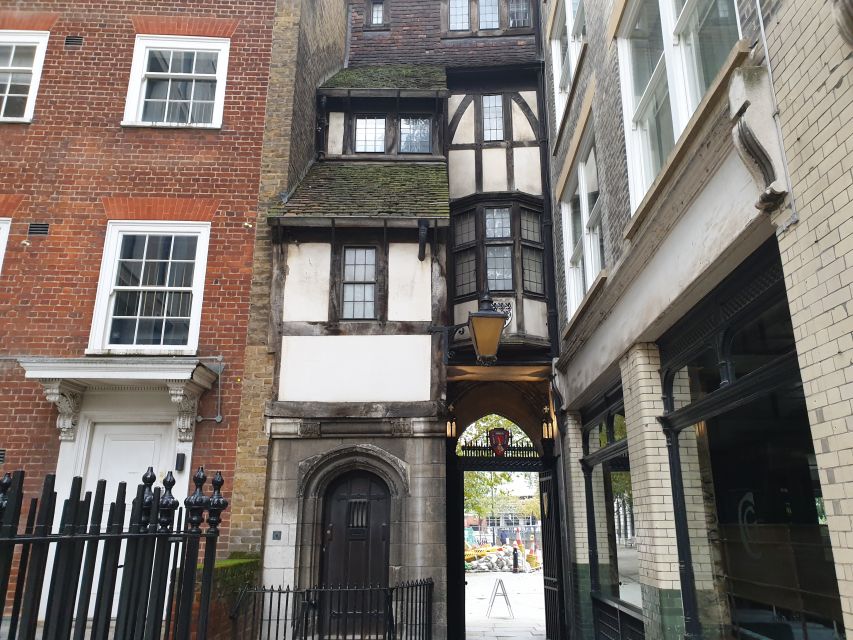
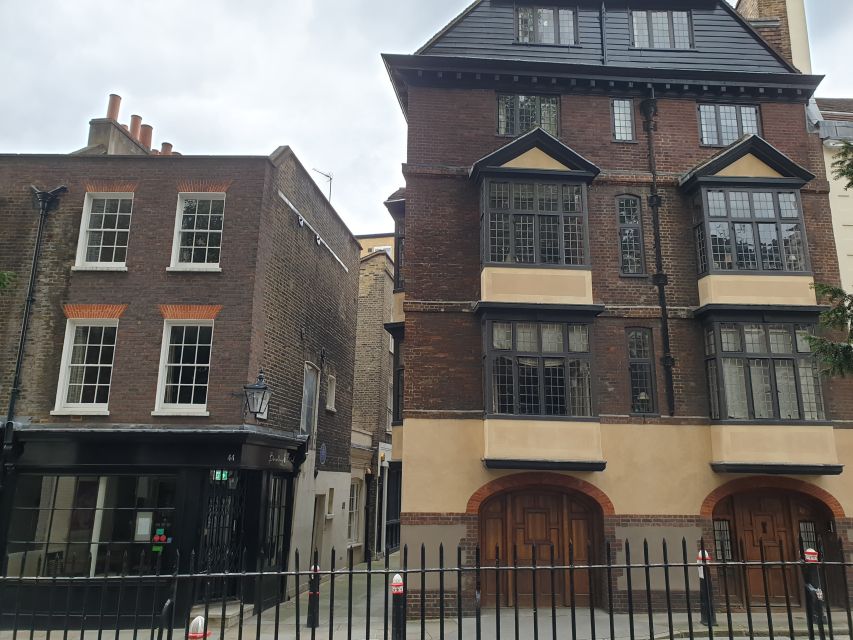
Cloth Fair gives the tour its strongest connection to Charles Dickens. The area became a notorious slum, and Dickens used this part of London as the setting for Oliver Twist. You will hear how the district’s poverty and overcrowding shaped its reputation.
This is where the tour moves from medieval violence into the social problems of later London. The connection to Dickens is not just a literary footnote. It helps you picture how the city’s poorest residents lived and how writers turned those conditions into a public story.
I like this part because it gives the route emotional range. You are not hearing only about famous executions. You are also considering the ordinary people who lived near the markets, churches, and alleys, often with little power over the conditions around them.
Cloth Fair may not provide a dramatic attraction in the usual sightseeing sense. Its value comes from explanation. Without a guide, you might walk through without understanding why Dickens chose this area or how its reputation developed.
St Bartholomew the Great and St Bartholomew’s Hospital
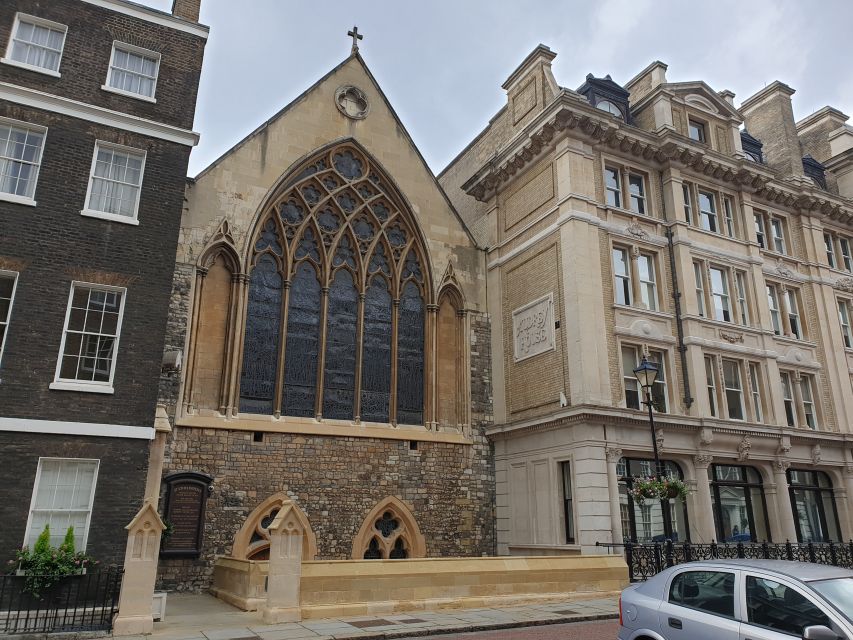
St Bartholomew the Great adds an important religious and medical dimension. The church is part of the same dense urban story, where faith, illness, charity, and death were never far apart.
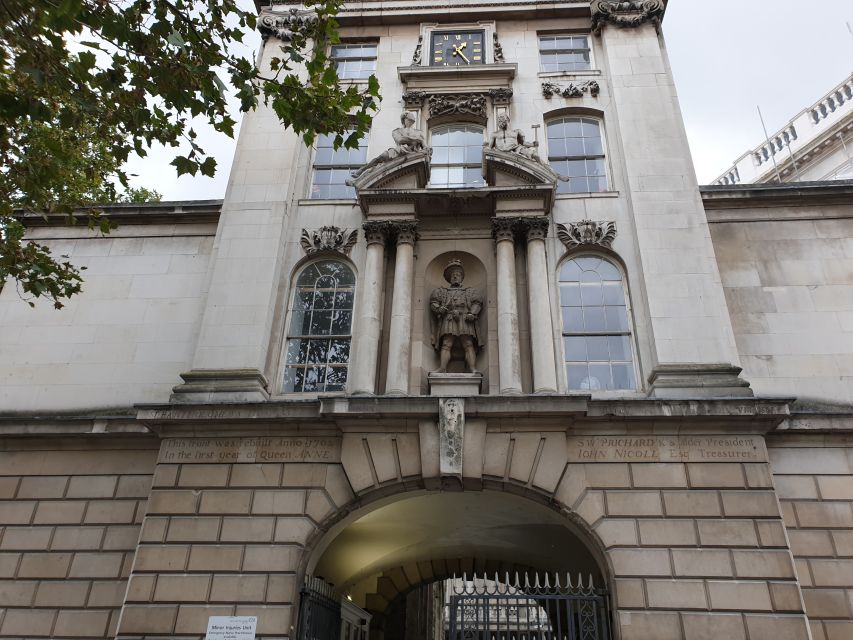
The route then takes you to St Bartholomew’s Hospital. Together, these stops help show that Smithfield was more than a place of punishment and meat production. It was also a place where people sought care, worshipped, worked, and died.
If the church is open to the tour, take the chance to look around rather than treating the stop as a quick photo opportunity. The interior visit is subject to services, and the tour may need to remain outside if worship is taking place. That uncertainty is normal for a walking route using active churches, so keep your expectations flexible.
The sequence also gives the guide room to answer questions. Celina from Germany specifically praised Tom for encouraging questions and responding to them throughout the two hours. That is useful if you want more than a fixed speech. Ask about the connection between the hospital, the church, and the surrounding district, and you should get more from the stop.
William Wallace and the reality behind Braveheart
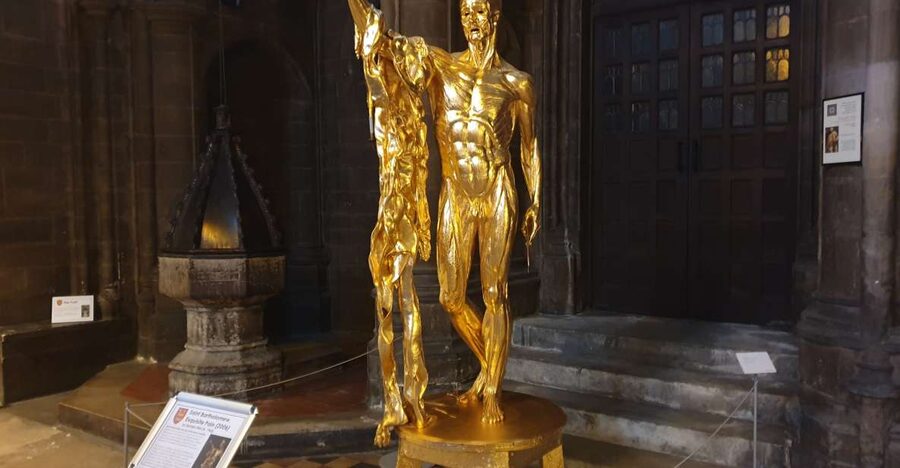
The Sir William Wallace Memorial is one of the route’s most recognizable named stops. Wallace is widely known through the film Braveheart, but the tour focuses on the actual circumstances of his death rather than the heroic movie version.
The grim joke about Wallace being in no condition to shout freedom during his execution captures the tone of the experience. You get the facts, but the guide uses humor to make them memorable without pretending the event was anything but brutal.
This stop suits visitors who enjoy history with a popular-culture hook. You do not need to know the film in advance, but recognizing the name makes the contrast between legend and reality easy to follow.
It is also a good example of the tour’s larger method. Famous names are used as entry points, then the story returns to the city itself. Wallace is not treated as an isolated celebrity. His memorial helps explain why Smithfield became associated with public punishment and political power.
The Golden Boy of Pye Corner and London’s changing shape
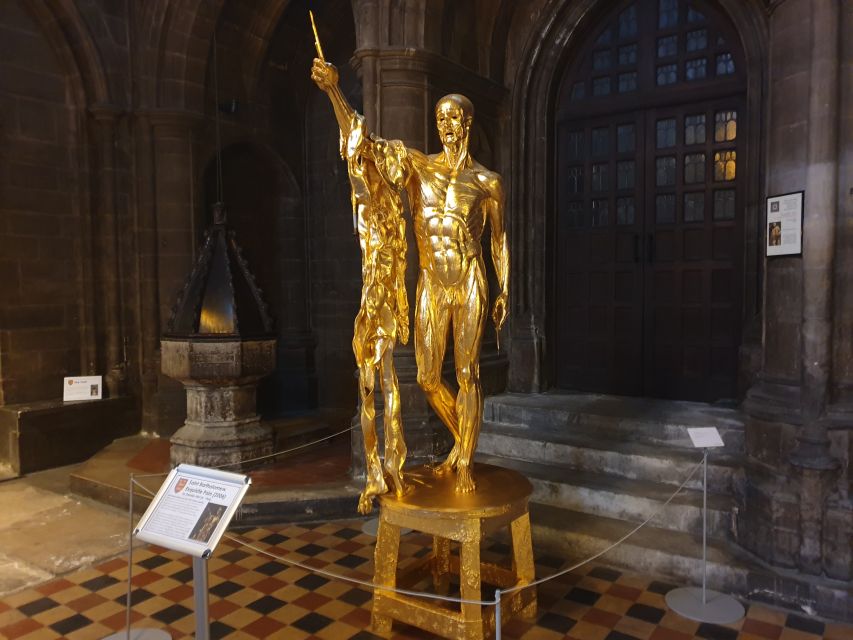
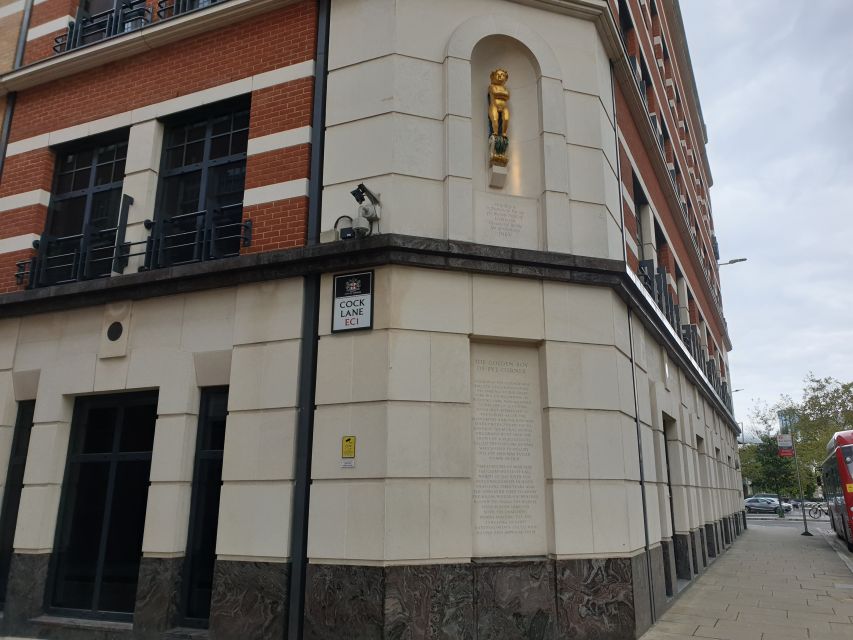
The Golden Boy of Pye Corner is a small but striking detail in the route. It connects to the Great Fire of London and the old idea that the disaster was caused by excessive indulgence. The stop shows how Londoners used public symbols to explain catastrophe and assign blame.
This is a useful change of pace after the heavier material about executions and plague. It also reminds you that the city’s past is full of stories that mix fact, belief, moral lessons, and local tradition.
The second Smithfield market stop, listed as London Central Markets, returns attention to the working history of the area. It may feel close to the earlier market discussion, but the repetition reinforces the main idea: Smithfield’s identity has long been tied to food, trade, and the treatment of bodies.
The value here is cumulative. By this point, you should have a clearer sense of how the same district changed use without losing its connection to the practical business of supplying London.
Ely Place and the walk’s quieter finish
The route ends at Ely Place, near Farringdon Station. This gives you a convenient onward transport point and a final setting that feels different from the market streets.
Ely Place is a fitting end because the tour has moved through several layers of London without requiring a long trek across the city. You begin at Barbican, pass through Charterhouse Square, Smithfield, St John’s Gate, Cloth Fair, the churches, the Wallace memorial, the hospital, and the Golden Boy, then finish within walking distance of Farringdon.
The route is compact, but the subject is large. A thousand years of history cannot be covered in full in two hours. The guide must select stories, and you should expect an engaging introduction rather than a complete academic account of every site.
That limitation is not a problem if you want a focused neighborhood walk. It would matter more if you hoped to see major interiors at length or study one period in detail. The tour favors connections and memorable stories over long visits at individual buildings.
Group size, guide style, and the $26 price
At $26 per person, the tour is reasonably priced for a live two-hour walk in central London, especially with a group capped at 15 people. You are paying for the guide’s narration and local connections, not for a large attraction ticket.
The small group limit should help with hearing the guide in city streets and asking questions at the stops. One group of eight was praised for enjoying the guide, and several comments singled out Tom’s delivery, humor, care, and ability to explain a wide range of subjects.
The strongest value comes if you like guided storytelling. You can walk through Smithfield for free, but you are unlikely to understand the Black Death burials, execution sites, Dickens connection, Wallace memorial, and local legends in the same connected way without a guide.
The price is less compelling if you dislike grim history or prefer to explore at your own pace. This is a structured walk with a clear theme. You should book it for the stories, not because it includes entry to a major paid attraction.
Free cancellation up to 24 hours before the start and reserve-now, pay-later booking make it easier to fit into a changing London schedule. The tour is conducted in English only, so you should be comfortable following a live English explanation for two hours.
Who should book this walk
I would recommend it to adults and older teenagers who enjoy:
- London crime and punishment
- The Black Death and medieval life
- Dickens and literary settings
- Stories that compare myth with historical fact
- Small-group walking tours
- Historic churches and lesser-known city streets
It is also a good choice if you have already seen London’s major sights and want a more focused neighborhood experience. The route shows a side of the city that is easy to miss when you spend your time around palaces, museums, and grand avenues.
I would skip it if you want a cheerful introduction to London, if graphic historical detail bothers you, or if you need a fully accessible indoor experience. The information provided confirms the two-mile distance and the possibility of church entry, but it does not give fuller accessibility details for the route.
Should you book Burnings, Butchery & Black Death?
Book this tour if you want a tightly focused, story-led walk through one of London’s most historically loaded districts. The combination of plague burials, public executions, Smithfield’s market past, Dickens, William Wallace, and church history gives you plenty of substance for the $26 cost.
The best reason to choose it is the guide. Tom has been praised for clear delivery, humor, patience with older participants, and willingness to answer questions. Just remember that the experience is deliberately gruesome, churches may not always be open, and the two-hour format offers a selective view rather than a full history of London.
FAQ
Where does the tour begin?
The tour begins just outside the Barbican Station exit on Aldersgate Street. Your guide will be holding an Historic London Tours sign.
Where does the tour finish?
The walk finishes at Ely Place, near Farringdon Station.
How long is the walking tour?
The tour lasts about two hours and covers roughly two miles.
What language is the tour conducted in?
The live tour guide conducts the experience in English.
Is church entry included?
Entry to churches is included when possible, but churches may not be visited if services are taking place.
Can children join the tour?
Children under 13 are not permitted to join this experience.
How many people can attend?
Ticket sales are limited to 15 attendees to keep the group small and make the guide easier to hear.
New listings around London
- London: Bermondsey Craft Brewery Tour★ 5.0 · 3 reviews
- Colourful Notting Hill Photography Tour★ 5.0 · 3 reviews
- The London Historic Pubs Tour★ 4.0 · 3 reviews
- Ultimate Royal London, Thames River Boat Ride & Walking Tour★ 5.0 · 3 reviews
- London: Wallace Collection & National Gallery Private Tours★ 5.0 · 3 reviews
- London: The Birthplace of The Rolling Stones Private Tour★ 5.0 · 3 reviews
- Historic pub tour with Brazilian guide (in Portuguese)★ 5.0 · 3 reviews
- London: Royal Tour with Westminster Abbey & Afternoon Tea★ 3.0 · 3 reviews
London Tours, compared.

Westminster to Greenwich River Thames Cruise
Read our review →
Magical London: Harry Potter Guided Walking Tour
Read our review →