Reviewed · GUIDED
Rochester, Kent: Costumed Guided Tour
Rochester’s past comes alive when a costumed character leads you through streets shaped by pilgrims, soldiers, prisoners, inventors, and Charles Dickens. The clever part is the mix of theatre and place: you hear Dickens’s words while standing among the buildings that inspired him.
I like the character-led storytelling, especially the full commitment of Mrs Dickens and the lively partnership between Mrs Dickens and Sir Joseph Williamson. I also like the route’s range, from Rochester Cathedral and castle views to small lanes, old gates, almshouses, and Dickens-linked houses.
The main consideration is pace. Ninety minutes is enough to see a great deal, but not enough to enter every attraction or linger at each stop. You will need comfortable shoes, and wet or windy weather can make the walking less pleasant.
Key points to know before you go
- Choose your historical viewpoint: Meet Victorian Rochester through Mrs Dickens or another period character, or see Regency Rochester with a French Napoleonic officer or Mrs Sarah Baker.
- Hear Dickens where Dickens belongs: Dramatic readings connect the streets, houses, and views directly with his writing.
- See 22 sites and four old city gates: The route covers major landmarks and easy-to-miss corners.
- Castle and cathedral views come included: You see both up close, but admission tickets to attractions are not part of the tour.
- Meet opposite Rochester station: The guide waits by the coach bays near the rear entrance to the Huguenot Museum.
- Expect theatre, not just facts: Guides stay in character, answer through the lens of their period, and use humour to keep the walk moving.
Why the character approach works in Rochester
A standard city walk can give you dates, names, and buildings. This experience adds a person from the past who can explain why those places mattered. That changes the way you look at Rochester.
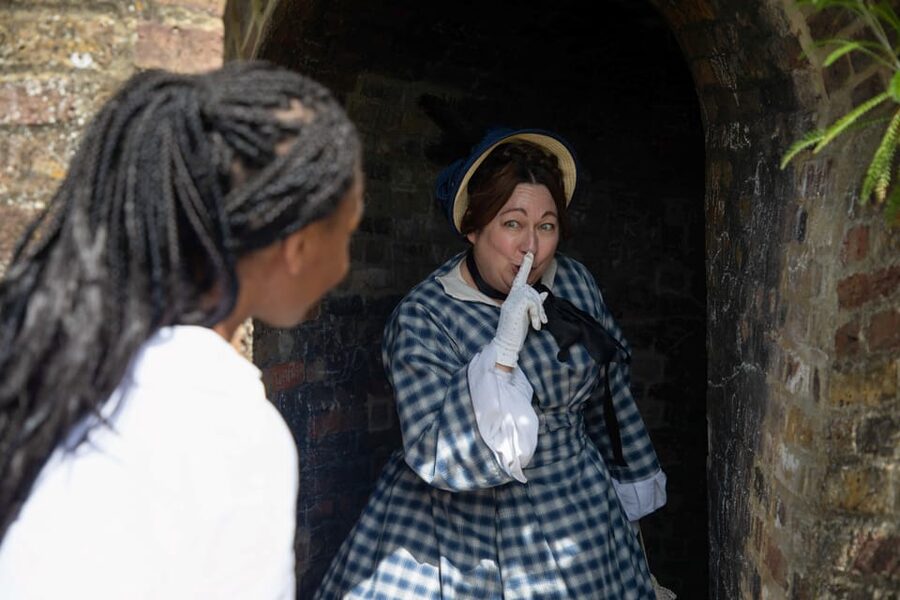
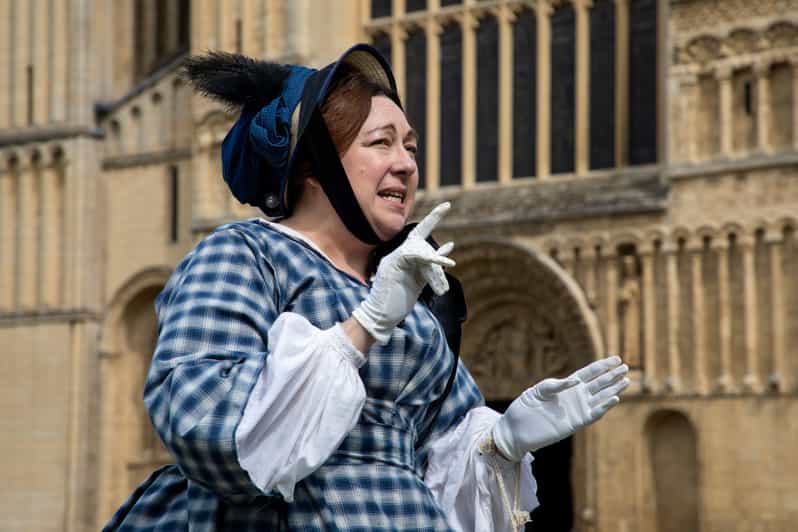
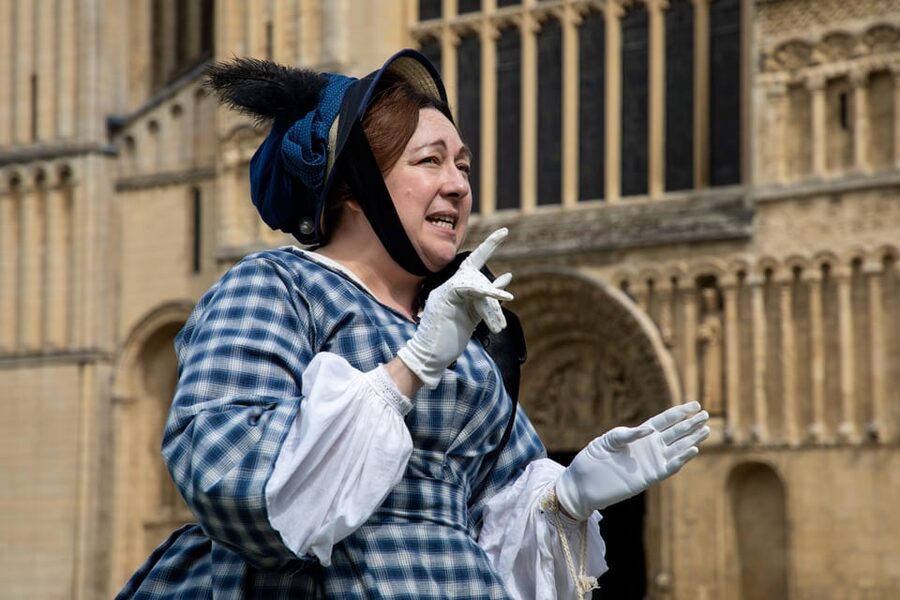
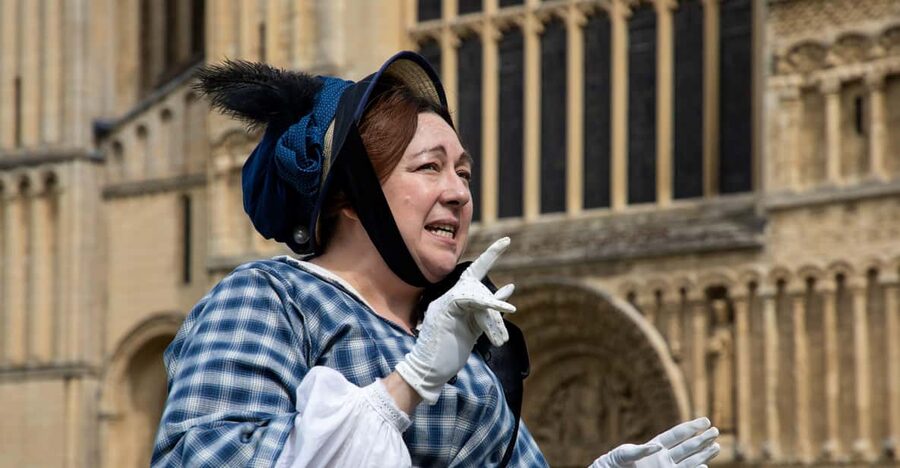
Mrs Dickens is the most obvious choice for anyone coming for Charles Dickens. She brings a personal angle to the town and its famous author, with stories about Rochester and her husband delivered through a Victorian character. The performance is not just a costume placed over a normal guided walk. The guide remains in character, which gives the route a light theatrical spark.
You can also meet other historical figures. A renowned botanical illustrator, a local inventor, and Sir Joseph Williamson are among the possible Victorian viewpoints. For an earlier setting, you can choose Regency Rochester with a French Napoleonic officer or Mrs Sarah Baker, a Georgian theatrical entrepreneur known as the Governess General of Kentish Theatre.
That choice matters. If you have read The Mystery of Edwin Drood or other Dickens works, Mrs Dickens gives you the strongest literary link. If you are more interested in social change, theatre, military connections, or the development of the city, another character may suit you better.
A handful of other Britain outings to weigh up
- Magical London: Harry Potter Guided Walking Tour
★ 4.7 · 22,044 reviews - London: Emirates Stadium Entry Ticket and Audio Guide
★ 4.7 · 5,513 reviews - Liverpool: City & Beatles Tour with Live Guide & Live Music
★ 4.8 · 5,249 reviews
Finding the start beside Rochester station
The meeting point is practical, but you need to look beyond the obvious station entrance. Leave Rochester station by the main exit and cross Corporation Street. Near the coach parking bays, look for the gate beside the rear entrance of the Huguenot Museum.
The words Welcome to Historic Rochester appear above the gate. Your guide waits on the ramp beside it. This is a useful starting point because you can arrive by train without arranging a taxi or finding your way through the old centre first.
The tour enters the High Street through a discreet route via the French Hospital. That opening helps set the tone. You do not simply walk from one large landmark to another. You begin by slipping into the older city through a less obvious entrance, much as the tour itself reveals parts of Rochester you could easily pass without noticing.
Wear shoes suited to a 90-minute walk. The route includes streets, lanes, and historic areas, and the tour continues in poor weather, as one October group discovered during strong wind and rain. The guide can amend the route for people with mobility requirements, but you should mention any special needs in advance.
Almshouses, gates, and the old cathedral city
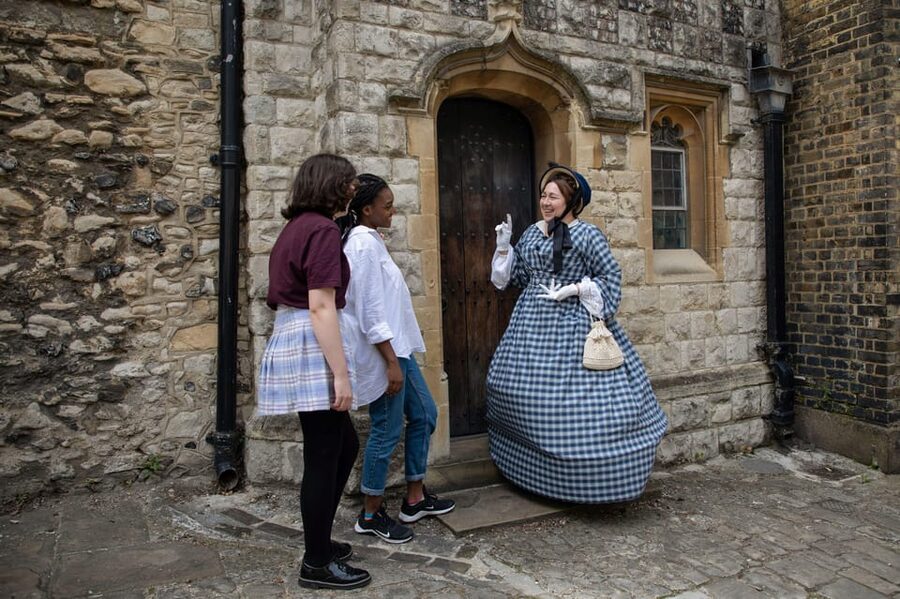
The first part of the walk introduces Rochester as a city shaped by movement. Pilgrims came for the cathedral. Refugees sought safety. Soldiers, sailors, prisoners, agitators, and people from far beyond Kent passed through these streets for very different reasons.
This social angle is one of the tour’s strongest features. You are not left with a picture of Rochester as only a medieval church town or a Dickens backdrop. The stories show how ordinary people and newcomers helped shape the place.
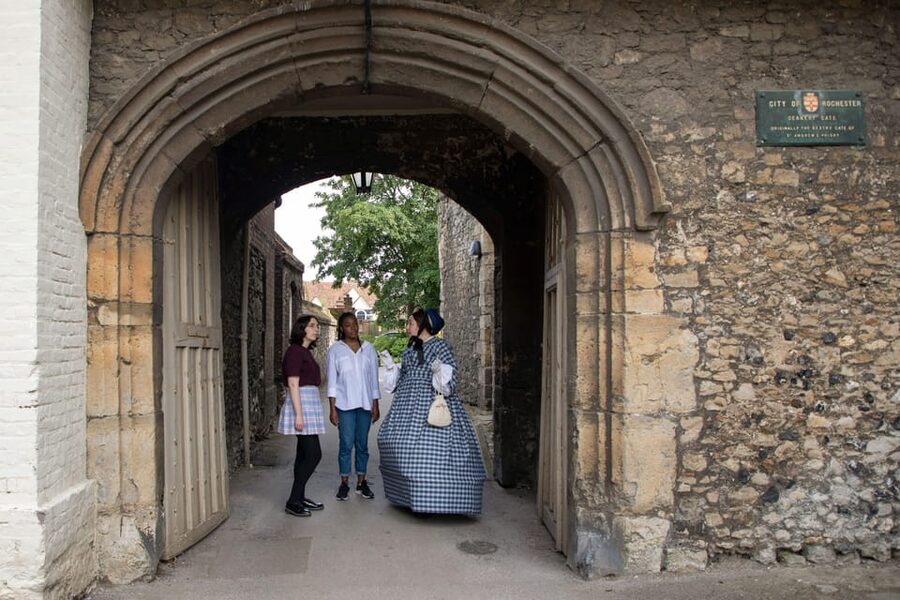
You see the almshouses and Dean’s Gate before reaching Rochester Cathedral. These stops help explain how religious institutions influenced the city’s layout and daily life. The cathedral is not merely an attractive building to photograph. It forms part of the story of pilgrimage, charity, authority, and local wealth.
The nearby church of St. Nicholas adds another layer. Rochester developed over many centuries, and the route uses its churches and gates to show how the city expanded, defended itself, and adjusted to changing needs.
You also pass Jasper’s Gate and Two Post Alley. These smaller features are exactly where a guide earns the ticket price. On your own, you might see an old passage or gate and continue walking. In character, the guide gives it a role in the city’s story.
The High Street’s inns, vaults, and civic power
The route then turns toward places tied to commerce, drinking, lodging, and local government. The George Vaults, the Guildhall, the Bull Hotel, and the Royal Crown each help build a picture of how Rochester worked as a town.
The old inns are particularly useful for understanding the city’s position on the River Medway. People arrived by road and river, needed somewhere to stay, and brought news, goods, arguments, and business with them. A town’s history is often easier to grasp through its inns and market life than through grand monuments alone.
The Guildhall shifts the focus to civic power. Here, the story moves from private homes and religious sites to the institutions that governed the city. You hear how Rochester’s identity developed as a cathedral city supported by river trade and the dockyard at nearby Chatham.
The guide’s humour keeps this section from becoming a list of old names. Several people who joined the walk found the characters witty as well as informative, and that balance is important. The performance gives you a reason to keep listening, while the buildings give the stories a physical setting.
Elsewhere in Britain, a change of pace:
- London: The London Eye Entry Ticket
★ 4.6 · 35,875 reviews - From London: Harry Potter Warner Bros Studio Tour
★ 4.7 · 26,588 reviews - London: Westminster to Greenwich River Thames Cruise
★ 4.5 · 22,836 reviews - London: Madame Tussauds London
★ 4.6 · 20,915 reviews
River Medway views and Rochester’s working wealth
Rochester’s relationship with the River Medway is central to the walk. The river brought wealth, connected the city to wider events, and supported the dockyard at Chatham. It also brought people from different parts of the country and the world.
The views help you understand the setting in a way that a map cannot. Look out across the Medway and consider the city not as an isolated historic quarter but as a place tied to shipping, defence, trade, and travel.
Rochester Bridge Trust forms part of this section. Bridges are practical structures, but they also control movement and commerce. Their maintenance, ownership, and tolls could affect the fortunes of a town.
The river views are a welcome visual change after the narrower streets. They also give the walk a pause before the castle and gardens. If the day is windy, you may feel the weather more strongly here, so bring a coat even in mild conditions.
Castle Gardens and the scars of medieval siege
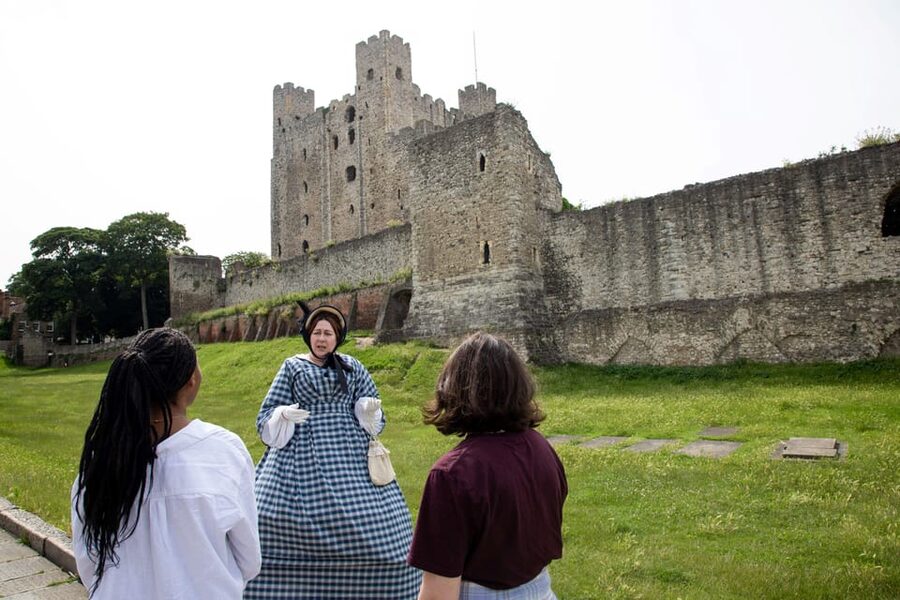
Rochester Castle is one of the walk’s major sights. You get close views of the castle and hear how it changed under a bloody medieval siege. The point is not simply that the castle is old. The stone carries evidence of conflict and adaptation.
The siege story gives the building a human scale. You can picture defenders, attackers, pressure on the walls, and the harsh reality behind the neat outline of a ruin. The guide explains how the castle’s appearance reflects what happened to it, making the structure easier to read.
Castle Gardens offer room to appreciate the setting. From here, you can take in the castle more clearly and enjoy views toward the river. I like this part because the tour gives you both the dramatic account and the quiet space to look.
There is an important practical limit. The experience provides close-up views and interpretation, but entry to Rochester Castle is not included. If you want to explore inside, plan a separate visit and allow extra time beyond the 90-minute walk.
Dickens’s Rochester, from Satis House to Eastgate House
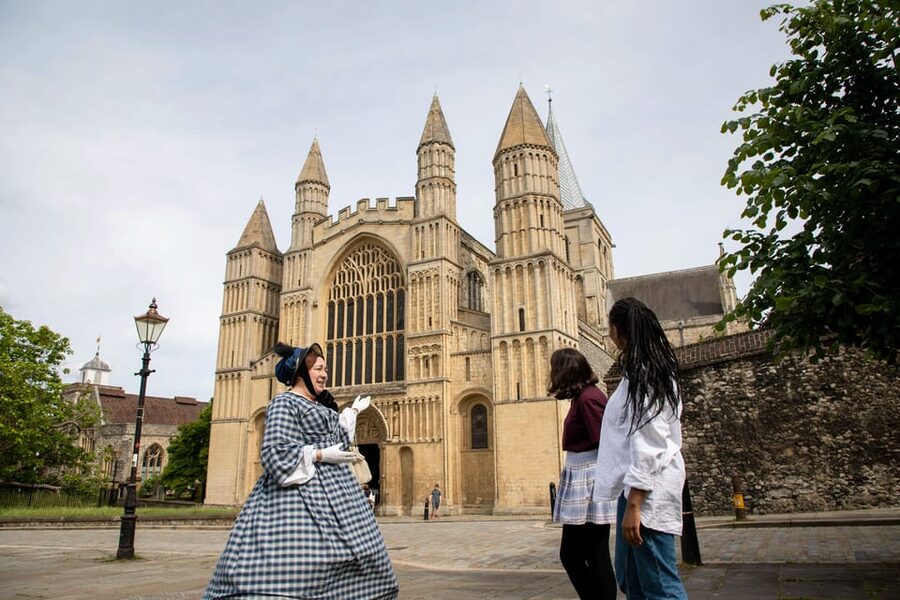
The Dickens section gives the tour its strongest literary pull. Rochester and the surrounding area directly inspired some of Dickens’s writing, and the route links his work to real streets and buildings.
Satis House is a key stop. You hear the Dickens connection while standing in the setting that helped shape his imagination. That is more satisfying than hearing a general lecture about an author in a room far from the places he knew.
You continue to Longley House, Boley Hill, Minor Canons Row, and The Vines. These places show how Dickens drew from architectural details, local characters, and the feel of a town. The route does not treat literature as something separate from daily life. It shows how houses, lanes, gardens, and local habits can find their way into fiction.
Restoration House is another important stop. Its connection with Dickens’s Rochester makes it especially useful for readers who want to understand how the author transformed familiar places into memorable fictional settings.
Eastgate House and the Swiss Chalet add further literary interest. The Swiss Chalet is connected with Dickens, while Eastgate House helps you see the sort of domestic and civic surroundings that fed his writing. The tour’s dramatic readings are most effective here because the words meet the location.
You also pass the memorial marking the last known sighting of Dickens. It gives the literary part of the walk a more personal ending. Instead of seeing Dickens only as a celebrated writer, you are reminded of his physical presence in Rochester and his final connection with the town.
Social stories at the Six Poor Travellers
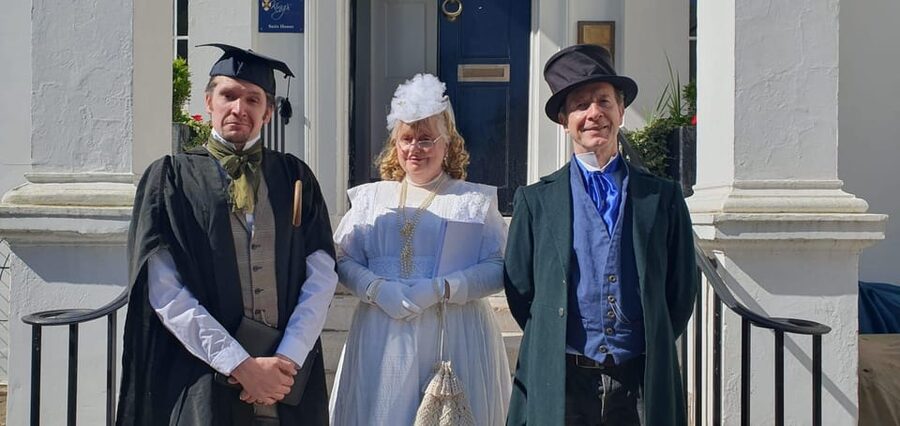
The Six Poor Travellers is among the most distinctive stops. Its name alone points to Rochester’s long tradition of charity and movement. The site connects the city’s religious and civic life with people who needed shelter and assistance.
This is where the tour’s social history becomes especially valuable. Grand buildings can tell you about wealth and power, but charitable foundations show how towns dealt with poverty and hardship. The guide places ordinary lives alongside the better-known stories of Dickens, kings, soldiers, and civic leaders.
The tour also refers to prisoners, refugees, sailors, and pilgrims. These are not decorative side notes. They help you see Rochester as a place where people arrived seeking release, sanctuary, work, or a new beginning.
That broader view makes the walk suitable for more than Dickens fans. You can come for the author and leave with a stronger sense of how the city functioned across centuries.
What the performance feels like in practice
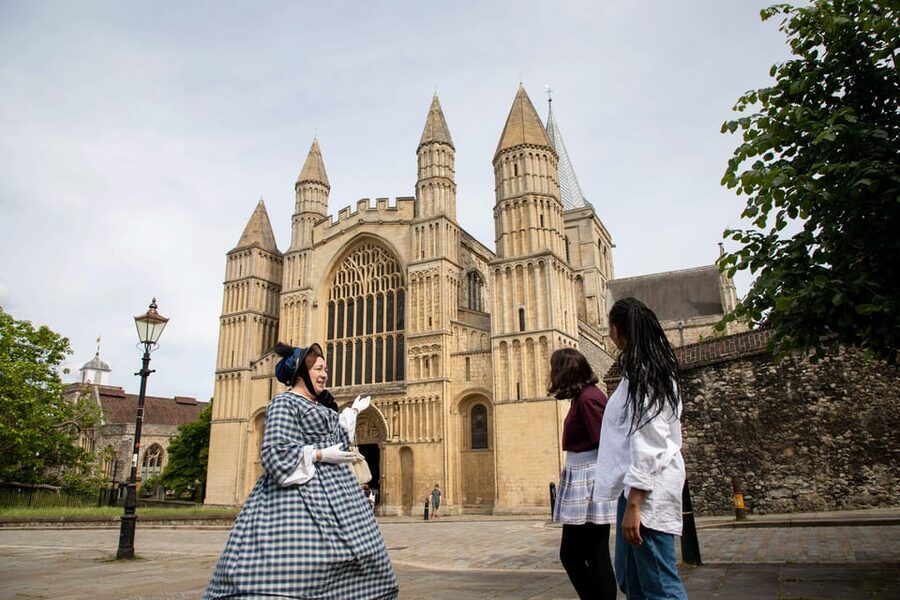
The costumed guides commit fully to their roles. Mrs Dickens, in particular, is presented as witty, personal, and firmly in character. Sir Joseph Williamson can appear as a companion character, creating a two-person exchange rather than a single voice explaining the streets.
That interaction adds surprise. The guide may point out a detail, shift into a reading, or reveal a local story in a way that feels more like a short scene than a museum label. The result is lively without requiring you to take part in a formal performance.
I would still set realistic expectations. This is a guided walk with theatrical elements, not a full stage production. If you want long explanations at every landmark or time for detailed photography, the pace may feel brisk.
The 90-minute length is part of the value. At $20 per person, you pay about $13.33 per hour for a live guide, dramatic readings, local stories, and a carefully arranged route through 22 sites and four gates. Since the tour does not include attraction admission, it works best as an introduction to Rochester rather than a complete day of paid sightseeing.
Who should book this Rochester walk?
I would recommend it to readers of Dickens, members of book clubs, and anyone who enjoys seeing literature in its real setting. It is particularly useful if you have read The Mystery of Edwin Drood, since the walk gives you a direct connection between the novel and Rochester.
It also suits people who want a compact introduction to the city. You see the cathedral, castle, river, old streets, civic buildings, historic homes, and charitable sites without spending a full day on a single attraction.
Families with very young babies may find the format less suitable, as babies under one year are not accepted. Older children who enjoy stories and costumes may respond well, but the supplied information does not give a specific child age recommendation.
The walk is also a good choice for a repeat visit. Even if you live locally, a character guide can point out corners you have passed many times without understanding. One local participant described it as worthwhile even for someone who already knew Rochester, and I can see why.
The tour is offered in English, with French also available according to the activity details. The live tour guide option listed for booking is English, so confirm the language you need when reserving.
Practical details that affect your choice
The tour begins and ends at 48 Corporation Street, opposite Rochester station’s main exit. That makes it easy to pair with a train journey and avoids the need to find the old centre first.
The walk lasts 1.5 hours. Food and drink are not included, and you do not need to expect a refreshment stop within the tour. Plan to eat before or after if you want more than a quick look at the city.
Attractions such as Rochester Castle may require their own admission ticket. The guide shows you the sites and explains their meaning, but this experience is not a substitute for entering every building.
Wheelchair access is supported, and the route can be changed for mobility needs if you tell the provider beforehand. The streets of an old city can still present practical challenges, so early notice is the sensible approach.
You can cancel up to 24 hours in advance for a full refund, and the reserve now, pay later option keeps your plans flexible. Alcohol and drugs are not allowed. Bring comfortable shoes, weather protection, and a camera if you want to record the buildings, though do not let photography distract you from the guide’s readings.
Should you book the Medway Arts Tours experience?
Book it if you want Rochester explained through people and stories rather than a plain list of dates. The strongest reasons are the committed character work, the Dickens connections, the close castle and cathedral views, and the way the route includes small lanes and social sites alongside major landmarks.
Skip it if you only want to enter the castle and cathedral, or if you prefer a slow, self-guided visit with no performance. You will need separate entry tickets for attractions and may find the 90-minute pace too quick for extended photography.
For most people, $20 is fair value for a focused first look at Rochester. Choose Mrs Dickens if Dickens is your main interest, ask about the available character when booking, and arrive ready to walk. This is a small-scale, good-humoured way to meet an old city on its own terms.
FAQ
How long does the Rochester costumed guided tour last?
The tour lasts 1.5 hours, or 90 minutes.
Where does the tour start?
It starts at 48 Corporation Street, opposite the main exit of Rochester Train Station. Look near the coach parking bays for the gate beside the rear entrance of the Huguenot Museum.
How do I identify the meeting point?
Look for the gate with the words Welcome to Historic Rochester above it. The guide waits on the ramp beside the gates.
Where does the tour finish?
The tour returns to 48 Corporation Street.
What language is the tour offered in?
The tour is available in English. French is also available according to the activity information.
Is Rochester Castle admission included?
No. The walking tour includes views and historical information, but entry tickets to attractions are not included.
Is Rochester Cathedral admission included?
No attraction entry tickets are included in the tour price.
Is the tour wheelchair accessible?
Yes. The route can be amended for mobility requirements if you contact the provider in advance.
What should I bring?
Bring comfortable shoes. Weather protection is also sensible for this outdoor walking experience.
Can I cancel the booking?
Yes. You can cancel up to 24 hours in advance for a full refund. A reserve now, pay later option is also available.
New listings around Britain
- Brighton Delicious Donut Adventure by Underground Donut Tour★ 5.0 · 14 reviews
- From Cambridge: Guided Day Tour to Bath and Stonehenge★ 4.8 · 14 reviews
- From Southampton: Stonehenge & Salisbury Private Day Trip★ 4.9 · 14 reviews
- Edinburgh: Stirling, Whisky & St Andrews Tour in Italian★ 3.9 · 14 reviews
- Blackpool: Viva Decades Rewind Show Ticket★ 3.9 · 14 reviews
- Royal Horticultural Society: Harlow Carr Garden Ticket★ 4.7 · 14 reviews
- London: GoBoat Rental in Canary Wharf with London Docklands★ 4.2 · 14 reviews
- London Royal Tour – Buckingham Palace Entry – 12 guests 2,5h★ 4.9 · 14 reviews
Guided, compared.

Magical London: Harry Potter Guided Walking Tour
Read our review →
Emirates Stadium Entry Ticket and Audio Guide
Read our review →
City & Beatles Tour with Live Guide & Live Music
Read our review →
University and City Walking Tour with Alumni Guide
Read our review →
Christmas Lights Nighttime Bus Tour with Live Guide
Read our review →