
Reviewed · BRISTOL TOURS
Bristol: Air Raid Shelter & St. Nicholas Market Walking Tour
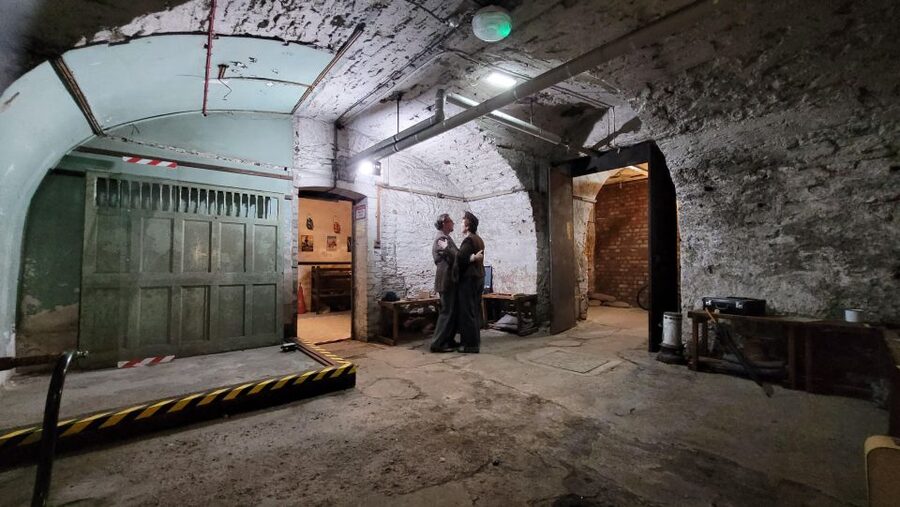
Beneath Bristol’s Corn Exchange lies a largely untouched WWII air raid shelter, a place most people pass above without knowing it exists. This tour links that underground time capsule with old streets, wartime damage, Bristol’s trading past, and the food stalls of St Nicholas Market.
I like the way the experience joins two very different parts of Bristol: the city’s 1,000-year trading story and the hard, personal realities of the Blitz. I also like the guides’ strong sense of purpose, especially Owen and Duncan, who bring the shelter to life with clear storytelling and period character.
The main drawback is that the shelter is still developing as a museum, so you get more guided interpretation than polished exhibition space. The underground sections also rule this out for people with mobility impairments or claustrophobia.
Key points to know before booking
- The shelter is the star: See Bristol’s largest public air raid shelter beneath the Corn Exchange.
- The walking tour sets the scene: Old City streets reveal Blitz damage, architecture, and Bristol’s trading past before you go underground.
- The guides make the difference: Owen, Duncan, and Theresa are praised for lively storytelling, humour, and period presentation.
- Music history is tucked upstairs: Enter Corn Exchange rooms associated with major 1960s bands, including the Rolling Stones.
- St Nicholas Market finishes the experience: You can buy sweet and savory food and souvenirs after the guided sections.
- Allow between 75 minutes and two hours: The pace and amount of time spent at each part can vary.
Why the air raid shelter makes this Bristol tour different
Many city walks stay above ground. This one takes you below the streets into a surviving wartime shelter beneath the Corn Exchange, giving the tour a strong sense of place that photographs and plaques cannot quite provide.
The shelter is presented as a time capsule. It has not been turned into a glossy museum, and that is both its appeal and its limitation. You see a real, preserved space and hear about the conditions people faced during bombing raids. At the same time, some areas remain rough, and the museum display is still being developed.
I think that unfinished quality suits the subject. The shelter feels like a piece of Bristol that is still being rescued and explained, rather than a fully packaged attraction. Your guide does much of the work, using stories, objects, and the rooms themselves to help you picture wartime Bristol.
The experience is also linked to the site’s future. Several people who have taken the tour hope the shelter receives stronger support and preservation. By booking, you are not only seeing an unusual part of the city, but also helping keep attention on a place that could otherwise remain closed or overlooked.
More markets in Bristol:
- Secrets of London Bike Tour: Thames, Tower Bridge & Market
★ 4.8 · 42 reviews
Starting at the Corn Exchange
Meet at the main entrance of the Corn Exchange. This is a useful starting point because the building connects several strands of the tour: commerce, entertainment, wartime Bristol, and the shelter below.
Before heading underground, your guide leads you through the surrounding Old City. The streets here are not just a route between attractions. They provide the setting for Bristol’s long trading story and show how the city changed through commerce, conflict, and modern urban life.
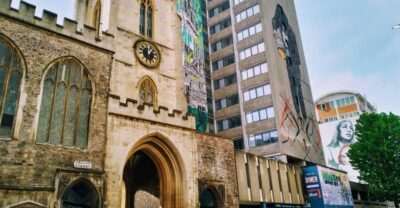
The guide points out striking buildings and the marks left by the Blitz. Areas around the Temple Church, Wine Street, and Corn Street feature in the wartime account, helping you understand that the air raids were not an abstract event on a timeline. They affected streets, businesses, homes, and the daily rhythm of the city.
This opening section is especially useful if you are new to Bristol. You get a quick orientation to the old centre while learning why the shelter matters. If you already live in Bristol, do not assume you will hear nothing new. Several local participants discovered details about the bombing raids and city development that they had never encountered before.
Guides have included Owen, Duncan, and Theresa. Their approach can vary, but the strongest element is their personal commitment to the subject. Owen often uses a WWII costume and lively character presentation, while Duncan is closely involved in developing the attraction. Expect a talk that is performed as much as delivered, with humour alongside the serious material.
Bristol’s trading past in the Old City
The first guided walk reaches back far beyond the Second World War. Bristol grew through trade, and the streets around the Corn Exchange and St Nicholas Market offer a natural place to discuss that development.
You will hear about the city’s ancient origins and its role as a trading centre across roughly 1,000 years. The tour does not treat Bristol as a collection of isolated monuments. Instead, it connects the buildings and streets to the business conducted there, then shows how war damaged parts of this older urban fabric.
I like this structure because it gives the shelter a wider setting. Without the Old City walk, the underground visit could feel like a stand-alone wartime attraction. With it, you see Bristol as a city layered with commerce, architecture, music, conflict, and present-day life.
The walking portion is also a good reminder to look up. The tour promises spectacular architecture, and the guide’s commentary helps explain what you are seeing rather than leaving you to identify buildings on your own. You will spend time outside, so comfortable shoes are the sensible choice.
The route is not described as a strenuous hike, but it does involve walking through old streets and later entering an underground site. If you need step-free access or find enclosed spaces difficult, this is not the right choice.
Going below the Corn Exchange
The transition underground is the tour’s biggest moment. Your guide leads you into Bristol’s largest public air raid shelter, a space usually unavailable to the public.
This is not a reconstructed wartime set. The value comes from seeing a real shelter and standing in rooms that retain their original atmosphere. Your guide explains what it was like for civilians during the raids and how people had to cope with noise, fear, crowding, and uncertainty.
The strongest guides turn the shelter into a story rather than a list of dates. Owen has been particularly praised for helping people picture what it must have felt like to be there. Duncan’s presentation also focuses on making the site feel alive through conversation, tales, and physical details.
You may meet Margaret, the shelter’s friendly ghost. Treat that as part of the attraction’s folklore, not as a promise of a supernatural event. The ghost story adds a little local character without replacing the wartime account.
The shelter can be moving, but it is not a large museum. You may see WWII items and articles, yet some people would like more time to study the displays. If you enjoy reading every label and examining each object closely, you might find the guided pace a little brisk.
That is where the tour format helps and hinders. A guide can explain why an object or room matters, which is more useful than wandering through a bare space. But you may want extra time for questions or quiet inspection, especially if the group is interested in the developing museum.
Elsewhere in Bristol, a change of pace:
- Bristol: Blackbeard to Banksy Guided Walking Tour
★ 4.9 · 1,422 reviews - From Bristol: Stonehenge and Cotswold Villages Day Tour
★ 4.8 · 717 reviews - From Bristol: Oxford and the Cotswolds Full-Day Tour
★ 4.7 · 244 reviews - Bristol: Guided Ghost Tour
★ 4.8 · 193 reviews
Corn Exchange rooms and 1960s music
The Corn Exchange adds another unexpected layer. Along with exclusive access to the shelter, the tour includes rooms linked to the building’s musical past.
These rooms once hosted some of the best bands of the 1960s, including the Rolling Stones. It is a short but memorable contrast to the wartime material. One moment you are hearing about civilian shelter life, and the next you are in rooms connected with the sound and energy of a later generation.
The music connection also helps explain why this is more than a military-history visit. You get several glimpses of Bristol’s changing identity: a trading city, a bombed city, a place of live music, and a modern food-market destination.
The information provided does not promise a full music exhibit, concert reconstruction, or long stop devoted only to bands. Think of this as an extra layer within the Corn Exchange visit. If music history is your main interest, you may want to keep expectations measured. If you enjoy unexpected details, it is a worthwhile part of the route.
Ending at St Nicholas Market
The tour finishes at St Nicholas Market, where you can buy food and souvenirs. Sweet and savory treats are not included in the $16 price, but the market gives you an easy way to continue the outing after the guided portion.
This is a practical ending. You do not finish in an empty square and then have to search for lunch. You can look around the covered market, choose from street-food options, and browse for a small souvenir.
The market also completes the tour’s central theme. You begin with Bristol’s trading past and finish in a living market where buying, selling, eating, and browsing still shape the city centre.
The tour information gives two possible drop-off points, St Nicholas Market and the Corn Exchange. Confirm the precise finish with your guide on the day, particularly if you have arranged to meet someone or have another booking afterward.
Some schedules describe the experience as about 75 minutes, while the itinerary can extend closer to two hours. That difference matters if you are planning lunch, a museum visit, or a train connection. I would leave a little spare time rather than treating the shorter figure as guaranteed.
How much value do you get for $16?
At $16 per person, this is a good-value tour if you care about local history and unusual access. The price includes the guide, entry to the WWII shelter, and access to areas of the Corn Exchange that are not normally open to the public.
You are paying for interpretation as much as admission. The shelter by itself might not explain every detail, while a standard city walk might never reach it. Combining both gives you a fuller Bristol experience for less than the cost of many major attractions.
Food and drink cost extra, but that is easy to manage because the walk ends at St Nicholas Market. You can choose how much to spend rather than paying for a fixed meal.
The value is strongest for visitors who want something specific to Bristol. This is not a generic old-town walk that could be swapped for one in another British city. The shelter, Corn Exchange rooms, local Blitz stories, and market finish give it a clear identity.
The value is slightly less certain for someone seeking a polished museum. Displays are still being developed, and the shelter needs further care and renovation. You should book for access and storytelling, not for a large collection of finished galleries.
Who should take this walk?
I would choose this tour if you enjoy wartime history, old city streets, and places that are normally closed. It also suits families and mixed-age groups because the guide-led format adds humour and character rather than presenting a long, dry lecture.
It is a smart choice for Bristol residents, too. The route can change the way you see familiar streets, especially around St Nicholas Market and the Corn Exchange. Local knowledge of the streets does not guarantee knowledge of what lies beneath them.
The tour also works well for a short Bristol visit. In one outing, you cover old-town history, WWII Bristol, an unusual underground site, music history, and a major market. You can then eat at St Nicholas Market without crossing the city.
You should skip it if you dislike enclosed spaces, have mobility limitations, or cannot manage the walking and underground access. The experience is not suitable for people over 300 pounds, people over 95 years old, or people with claustrophobia, according to the stated restrictions.
The tour is in English, so you should be comfortable following a live spoken explanation. Comfortable shoes are the only listed item to bring, but sensible footwear still matters on a walking route that includes old streets and a subterranean shelter.
Timing, cancellation, and practical planning
The stated duration ranges from 75 minutes to two hours. Some people find the shorter version is just right, while others wish they had more time for questions and the museum items. Plan for the longer end if you want an unhurried morning or afternoon.
You can cancel up to 24 hours before the start for a full refund. You can also reserve now and pay later, which helps if your Bristol plans are still shifting.
Food and drink are not included. That is not a serious weakness here, since St Nicholas Market provides the natural place to buy lunch or a snack at the end.
Arrive at the main entrance of the Corn Exchange. The supplied meeting details list the Corn Exchange and St Nicholas Market as possible location points, but the clear meeting instruction is the Corn Exchange entrance.
My verdict on the Bristol air raid shelter tour
I would book this if you want a personal, place-based look at Bristol rather than a standard sightseeing circuit. The shelter is the reason to go, but the Old City walk makes the visit more meaningful by showing how wartime Bristol fits into the city’s longer trading story.
The guides are the strongest part of the experience. Owen, Duncan, and Theresa are presented as energetic and committed, and their storytelling gives shape to a site that is still being developed. Expect warmth, humour, period character, and plenty of spoken detail.
Go with realistic expectations. This is not a finished museum, the schedule can run from just over an hour to nearly two, and some people may want more time with the displays. For $16, though, the access to the shelter and Corn Exchange rooms makes it a strong buy.
Book it if the idea of standing beneath St Nicholas Market in a real WWII shelter appeals to you. Skip it only if enclosed spaces, walking, or an unfinished exhibition would outweigh the appeal of seeing a very unusual side of Bristol.
FAQ
Where does the tour begin?
Meet at the main entrance of the Corn Exchange.
How long does the tour last?
The activity is listed as lasting between 75 minutes and two hours. Check the available start time and allow extra time if you have plans afterward.
What language is the tour conducted in?
The tour is conducted in English with a live English-speaking guide.
Is entry to the WWII air raid shelter included?
Yes. Entry to the WWII air raid shelter is included in the tour price.
Does the tour include access to the Corn Exchange?
Yes. The price includes entry to exclusive areas of the Corn Exchange, including rooms connected with major 1960s bands such as the Rolling Stones.
Is food included?
No. Food and drink are not included, but you can buy sweet, savory, and street-food options at St Nicholas Market.
What should I bring?
Bring comfortable shoes for the Old City walk and the underground visit.
Is the tour suitable for people with claustrophobia?
No. The activity is listed as unsuitable for people with claustrophobia.
Can I cancel for a refund?
Yes. You can cancel up to 24 hours in advance for a full refund. You can also reserve now and pay later.
More Walking Tours in Bristol
- Magical London: Harry Potter Guided Walking Tour
★ 4.7 · 22,044 reviews - London: The Original Jack the Ripper Walking Tour
★ 4.7 · 7,833 reviews - Oxford: University and City Walking Tour with Alumni Guide
★ 4.7 · 4,429 reviews - London: Harry Potter Movies Walking Tour (Kids Go Free)
★ 4.7 · 3,071 reviews
New listings around Bristol
- Bristol: Bristol Zoo Project Entry Ticket★ 4.3 · 18 reviews
- From Bristol: 4-Day Cornwall, Devon & Stonehenge Tour★ 4.3 · 22 reviews
- Bristol: The House Magicians Comedy and Magic Show★ 4.7 · 37 reviews
- Bristol: Brunel’s SS Great Britain Experience Entry Ticket★ 4.7 · 44 reviews
- St Mary Redcliffe Church Bristol: Guided Tour★ 4.7 · 67 reviews
- Bristol: The Best Of Bristol, Guided Bike Tour★ 4.8 · 68 reviews
- Bristol: Self-Guided Sightseeing Audio Tour★ 4.4 · 151 reviews
- Bristol: Wake The Tiger Amazement Park Entry Ticket★ 4.3 · 156 reviews
Bristol Tours, compared.



Browse the lists this tour appears in