
Reviewed · BRISTOL TOURS
St Mary Redcliffe Church Bristol: Guided Tour
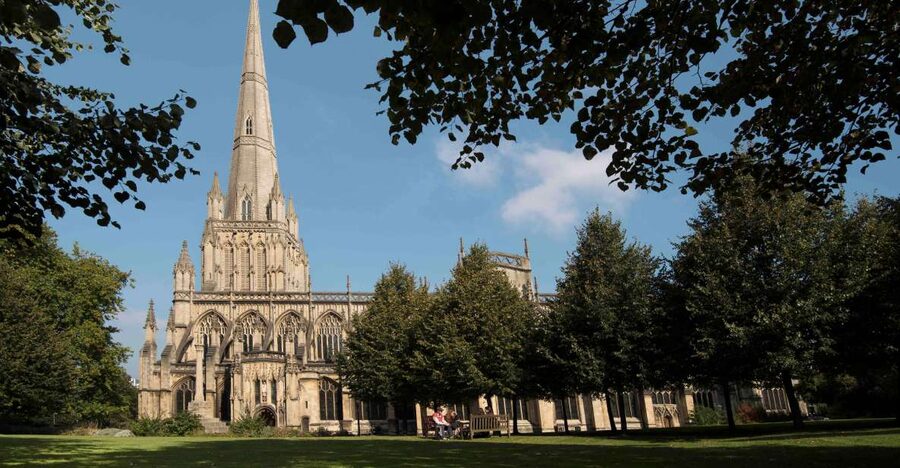
St Mary Redcliffe hides a remarkable amount inside its walls, from a mysterious medieval knight to merchant marks scratched centuries ago. The 90-minute guided tour also takes you into spaces usually closed to the public, including the Chatterton Room above the North Porch.
I like the tour’s clear route through the church and its mix of art, architecture, local characters, and maritime stories. I also like the chance to hear guides such as Bryan, Sarah, and Paul add personal touches, including organ demonstrations and stories about Bristol figures. The main consideration is the 75-step spiral staircase to the Chatterton Room, which is not suitable for everyone.
Key points to know before you book
- The North Porch sets the scene: Begin in a rare hexagonal medieval porch that once held a shrine to the Virgin Mary.
- The church has strong Bristol sea links: See John Cabot’s whalebone and a model of The Matthew, linked to his 1497 voyage.
- Look closely at the walls: Medieval graffiti and merchants’ marks survived for about eight centuries.
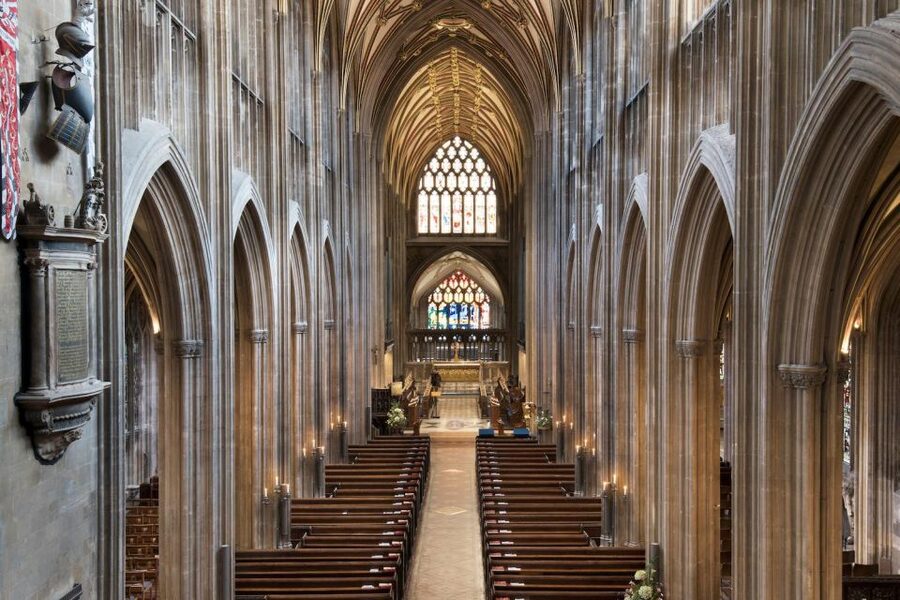
- The interior is the main event: Vaulting, roof bosses, soaring pillars, monuments, and stained glass reward a slow, guided look.
- The hidden-room visit requires effort: The Chatterton Room is reached by a 75-step spiral staircase.
- At $8, the tour offers strong value: You get 90 minutes, a live English-speaking guide, and access to areas usually closed to the public.
Why St Mary Redcliffe deserves a guided visit
St Mary Redcliffe was built and altered from the 12th through the 19th centuries. That long building story is part of its appeal. You are not looking at one neat block from one period. You are reading the changes made by parishioners, merchants, craftsmen, artists, and church leaders over hundreds of years.
Queen Elizabeth I called it the fairest, goodliest and most famous parish church in England. You do not need to take that grand praise at face value to appreciate the scale of the place. The soaring interior, tall windows, carved stone, and long view toward the chancel give the church an effect that is difficult to grasp from a quick self-guided visit.
I would choose the tour because it gives you a way to connect small details with the larger building. A guide can point out a scratched mark, explain why a tomb matters, and then help you see how both fit into Bristol’s medieval trading world.
The tour lasts 90 minutes, which is long enough to cover the main church without turning into an all-day commitment. It is also short enough to fit into a Bristol sightseeing schedule alongside the harbourside, nearby historic streets, or another city attraction.
A handful of other Bristol outings to weigh up
- Bristol: Blackbeard to Banksy Guided Walking Tour
★ 4.9 · 1,422 reviews - From Bristol: Stonehenge and Cotswold Villages Day Tour
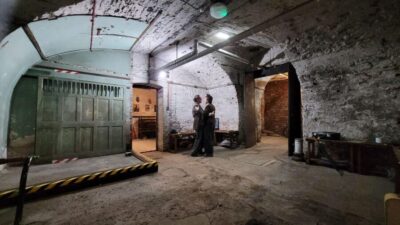
★ 4.8 · 717 reviews - Bristol: Air Raid Shelter & St. Nicholas Market Walking Tour
★ 4.8 · 320 reviews
Starting in the unusual North Porch
Your meeting point is inside the church, near the main entrance and visitor desk. The tour begins in the North Porch, one of the most distinctive parts of St Mary Redcliffe.
This hexagonal porch dates from the 12th or 13th century. It once functioned as the church’s main chapel and held a shrine to the Virgin Mary. That gives the first stop more weight than a simple architectural introduction. You are beginning in a place that had its own religious purpose, not merely passing through an entrance hall.
The outside carvings are another early highlight. They are described as exquisite and mysterious, so pay attention as your guide discusses the figures and decoration. The porch also gives you a good position from which to view the church tower and spire.
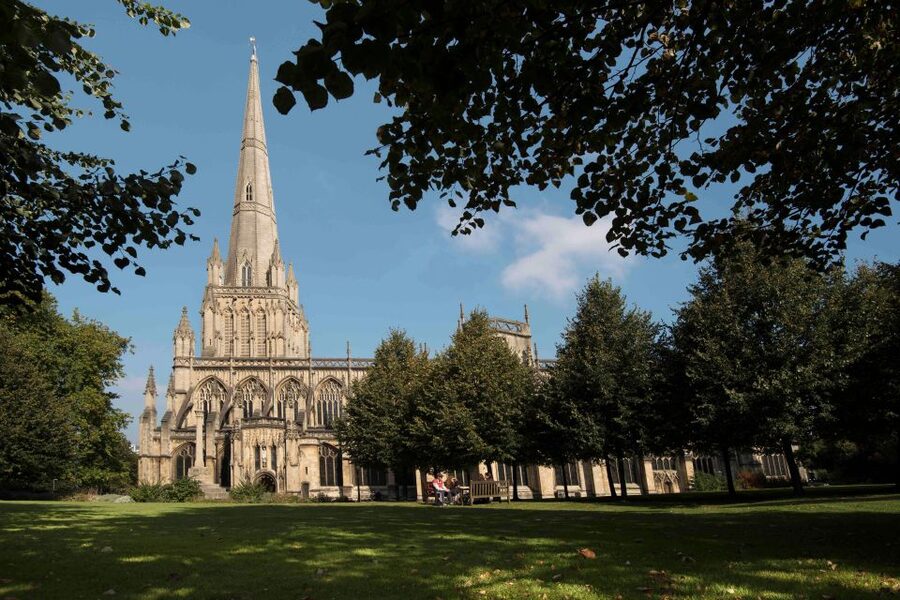
The spire is important to the church’s story. Lightning struck it, and its collapse damaged part of the nave. The later rebuilding was linked to William Canynges II, one of Bristol’s major merchant figures. This is a useful example of how the building’s architecture is tied to the city’s money and trade.
Reading Bristol’s maritime past in the church
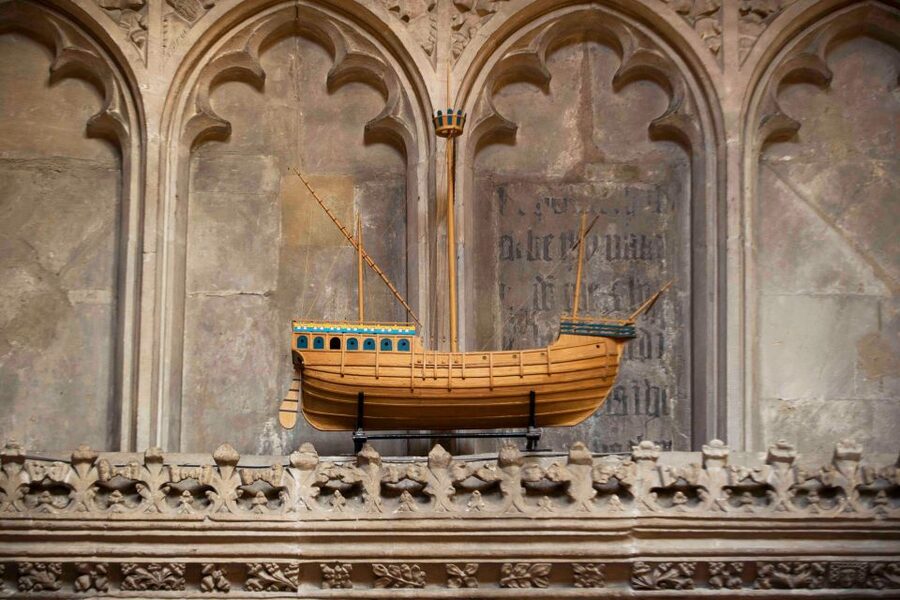
St Mary Redcliffe has a close connection with Bristol’s life at sea. Inside, you will see a whalebone associated with John Cabot’s 1497 voyage to North America aboard The Matthew. A model of the ship hangs above the main entrance.
These objects give the church a local, outward-looking character. You are not only studying medieval religion or Gothic design. You are also seeing how Bristol’s parish life connected with ships, merchants, voyages, and the wider world.
The whalebone is especially effective because it is an unexpected object in a church. It gives the tour a memorable point of reference and helps explain why Bristol’s wealthy trading families had such an influence on St Mary Redcliffe.
Guides may also bring attention to later civic and cultural connections. The church has links with royalty, merchants, artists, and poets, so the tour moves beyond a list of dates. You get a sense of the people who shaped the building and the city around it.
Medieval glass in St John’s Chapel
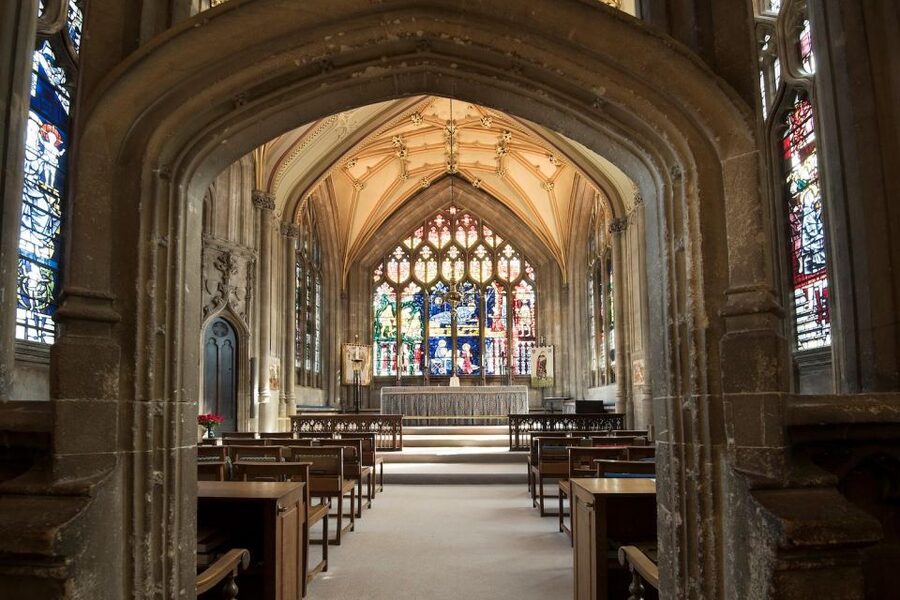
In St John’s Chapel, you will see some of the church’s remaining medieval stained glass, dating from the 14th century. This is one of the best stops for anyone interested in how medieval churches used colour and light.
Do not expect every window to survive in its original form. The value here lies in the surviving fragments and designs, and in the chance to understand how the chapel once worked as a visual and devotional space. Your guide helps you notice what is easy to miss when you look at a window from floor level.
Stained glass can be hard to interpret without context. A guide can explain its age, placement, and purpose while you are standing directly beneath it. That makes this section more useful than simply taking photographs and moving on.
The chapel also helps break up the tour. After the large scale of the porch and the church exterior, you get a closer look at craft and detail.
Elsewhere in Bristol, a change of pace:
- From Bristol: Oxford and the Cotswolds Full-Day Tour
★ 4.7 · 244 reviews - Bristol: Guided Ghost Tour
★ 4.8 · 193 reviews - Bristol: Wake The Tiger Amazement Park Entry Ticket
★ 4.3 · 156 reviews - Bristol: Self-Guided Sightseeing Audio Tour
★ 4.4 · 151 reviews
The full view from the west end
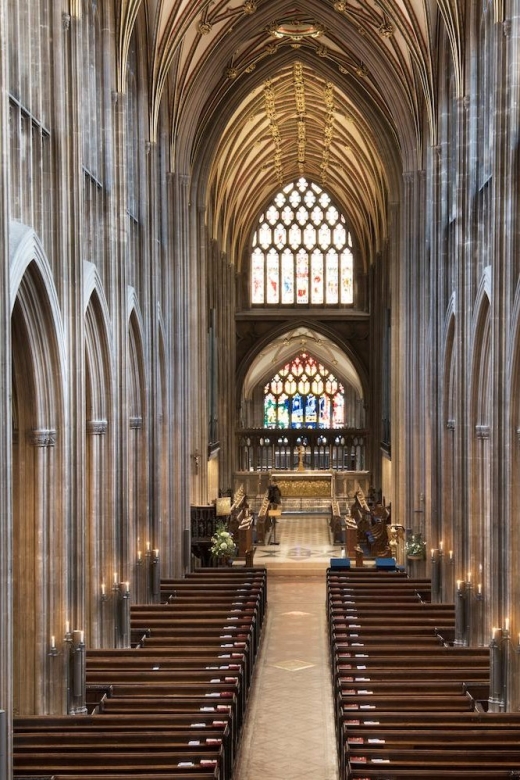
One of the strongest visual moments comes when you stand at the west end and look toward the chancel and altar. From here, the church’s height and length come together.
Look up at the vaulted ceiling, which contains more than 1,200 individual roof bosses. These are carved groin stones set into the vaulting. The number alone is striking, but the real benefit of the tour is learning to look at the ceiling as a collection of separate details rather than one distant surface.
The pillars are another major feature. They form part of what is described as one of England’s finest examples of Perpendicular Gothic architecture. You will see why the building feels tall and ordered, with vertical lines guiding your eye upward.
This is a good point to pause with your camera down. One visitor found the guide so absorbing that there was little time for photographs during the walk. That is a fair warning. If you want pictures, take a few before the tour or return afterward to photograph the details you missed.
The knight who may not be Robert de Berkeley
In the North Transept, you will meet one of the church’s best mysteries: an early medieval knight’s effigy.
The figure has long been linked with Robert de Berkeley, who gave the church a water supply in 1190. But the identity is not certain. The effigy may even be older than the church building itself.
I like this kind of uncertainty. It is more honest and often more interesting than a neat label with no questions attached. You will see the monument, hear the traditional association, and understand why historians remain cautious.
This stop also shows why a guided walk adds value. A label might tell you the name connected with the figure. A guide can explain the gap between tradition and proof, and why the uncertainty matters.
The Lady Chapel and later stained glass
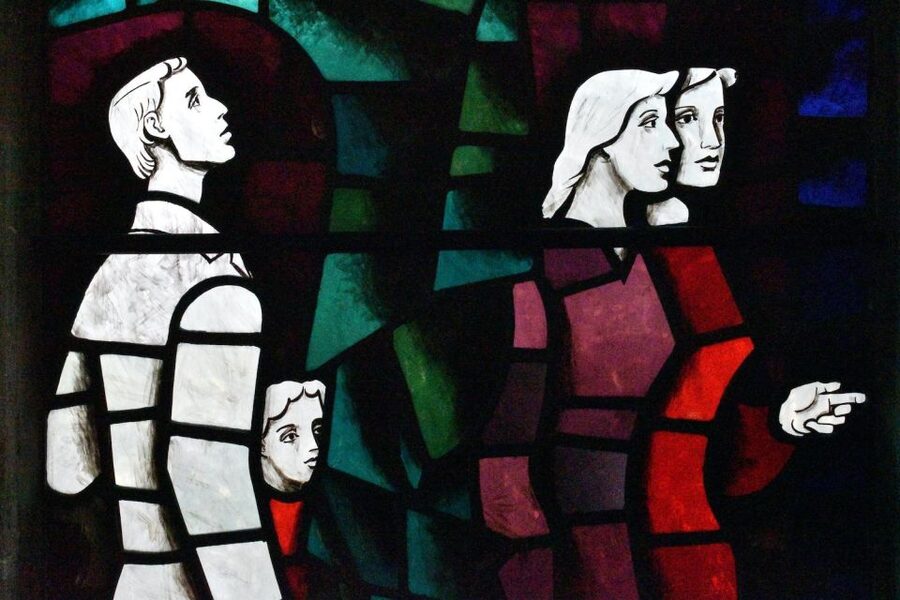
The 14th-century Lady Chapel brings together medieval structure and later artistic work. Its Gothic screen gives the space a strong sense of enclosure, while the stained glass windows were designed by Harry Stammers in the early 1960s.
That combination is useful for understanding St Mary Redcliffe as a living church rather than a frozen medieval display. Some parts date from the Middle Ages, while other elements belong to the 20th century. The building continued to be cared for, adapted, and decorated long after its first construction.
If you enjoy stained glass, this may be one of the most rewarding parts of the route. The windows are not simply old objects. Their placement, colour, and relationship with the screen give the chapel a distinct atmosphere.
The chapel is also a quieter counterpoint to the grand central view. I would take a moment here to compare the medieval stonework with Stammers’ more recent window designs.
William Canynges II and Bristol’s merchant wealth
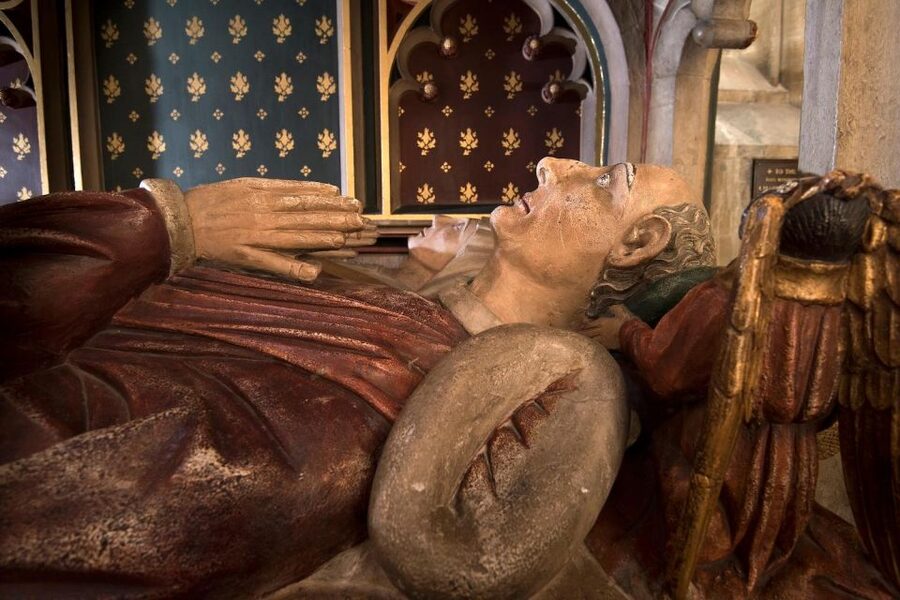
In the South Transept, you will see the polychrome stone altar tomb of William Canynges II and his wife, Joan. Canynges was an MP and Mayor of Bristol, and he belonged to the group of merchant princes who helped make the city wealthy.
His importance to the church goes beyond the tomb. He is credited with rebuilding St Mary Redcliffe in the 15th century after the lightning strike destroyed part of the nave.
This is where the church’s architecture and local history meet most clearly. Large medieval buildings needed money, labour, and influential supporters. Canynges’ tomb gives you a physical reminder of the people who funded and shaped the parish.
Look closely at the colour on the tomb. Polychrome stone is easy to overlook if you are expecting bare grey masonry. Your guide can help explain how colour once played a larger role in medieval church interiors than many modern visitors realise.
Graffiti, merchants’ marks, and overlooked details
The medieval graffiti may be the most rewarding feature for anyone who likes small human traces. Marks made by merchants and other people have remained on the church walls for about 800 years.
These are not polished works of art. That is exactly why they matter. A carved name, sign, or mark can show how ordinary people used and experienced the building. The marks also connect the church to the working life of Bristol, especially its merchants and commercial families.
You will need to look closely. The graffiti is not presented as a large display, and some marks are only now being identified. This is a place where the guide’s eye makes a real difference.
I would ask questions if you are curious about how the marks were dated or interpreted. The supplied tour details do not promise a full specialist study of every inscription, but they do make clear that the guide will draw your attention to this growing area of interest.
Above the porch in the Chatterton Room
The final hidden space is the Chatterton Room, high above the North Porch. It is linked with Thomas Chatterton, the Bristol boy poet who lived from 1752 to 1770 and is widely recognised as the father of English Romantic Literature.
Getting there is part of the experience. You must climb a 75-step spiral staircase. The room is therefore not accessible to anyone unable to manage the stairs, though you can still join the main part of the tour if you cannot make the climb.
This is the clearest practical drawback. The church’s main body is accessible on a level through the south entrance, but the hidden-room portion is not. If stairs are a concern, contact the church before booking or make your needs clear when arranging the visit.
For those who can manage it, the room adds a sense of discovery without requiring a separate excursion. You are seeing a part of the building that normally remains closed to the public, along with a space tied to an important Bristol literary figure.
Guides who bring the church to life
The tour is led in English, and the guide makes a major difference to how much you take away. Bryan, Sarah, and Paul have all led tours, and the available experiences suggest different strengths depending on who is guiding on the day.
Bryan is a retired musical director, organist, and chorally trained musician. His tours have included an organ demonstration, which can add an unusual aural dimension to the visit. The organ was restored in 2009 and has five keyboards, 71 stops, and 4,327 pipes, some reaching 34 feet long.
An organ demonstration is not guaranteed as a formal part of every tour, so treat it as a possible extra rather than a promise. Still, it shows how a guide’s personal background can shape the visit.
Sarah has been praised for combining strong subject knowledge with an easy manner and humour. Paul has also been described as clear, energetic, and good at answering questions. The common thread is a relaxed pace and room for curiosity, rather than a rushed march from one object to the next.
Is $8 good value for 90 minutes?
At $8 per person, I consider this very good value. You are paying less than many major Bristol attractions charge for entry alone, yet this ticket includes a 90-minute guided walk and access to spaces normally closed to the public.
The value is strongest if you already care about architecture, church history, local people, or overlooked details. A casual visitor who only wants a quick look inside may not need the full tour. But if you want to understand why the church matters, the guide adds far more than an information board can provide.
You also get several different experiences in one visit: medieval carving, surviving glass, maritime objects, monuments, graffiti, Gothic architecture, and a literary connection. The route keeps changing scale, from tiny wall marks to the full sweep of the vaulted interior.
You can reserve now and pay later, and free cancellation is available up to 24 hours before the tour for a full refund. Starting times vary, so check availability when planning your day.
Who should book this church tour?
I would recommend it to first-time visitors who want a strong introduction to St Mary Redcliffe, as well as returning visitors who have looked around before but missed the upper rooms and small details.
It suits:
- Architecture fans interested in Perpendicular Gothic design
- People curious about medieval art, monuments, and stained glass
- Visitors who enjoy local stories tied to merchants, poets, and seafaring
- Anyone who likes unusual details such as graffiti, a whalebone, and an unidentified knight
- Repeat visitors who want access to parts of the church normally closed to the public
Families may enjoy the variety of objects and stories, though the 75-step spiral staircase may not suit every child or adult. Anyone with limited mobility can still take part in the level sections of the tour, but should understand that the Chatterton Room cannot be reached without climbing.
Should you book St Mary Redcliffe’s guided tour?
Yes, if you want more than a quick look at a beautiful church. For $8, you get a focused 90-minute introduction to one of Bristol’s most important buildings, with access to the Chatterton Room and other details you could easily miss alone.
Book it especially if medieval graffiti, stained glass, merchant history, or Gothic architecture interests you. If you cannot climb the spiral staircase, the main church is still worth seeing and you can join the accessible portion, but the hidden-space part will not be available.
The best reason to go is the mix of grand and personal details: 1,200 roof bosses overhead, a whalebone tied to a famous voyage, a tomb linked to Bristol’s wealth, and small marks left by people centuries ago. That combination gives you a much sharper sense of the church and the city around it.
FAQ
How long is the St Mary Redcliffe guided tour?
The guided walking tour lasts 90 minutes.
How much does the tour cost?
The price is $8 per person.
What language is the tour in?
The live guided tour is conducted in English.
Where does the tour meet?
Meet inside St Mary Redcliffe near the main entrance, by the visitor desk.
Can I visit the Chatterton Room if I cannot climb stairs?
No. The Chatterton Room is reached by a 75-step spiral staircase. Most of the main tour takes place on a level and is accessible through the south entrance, so you may still join the main part of the visit.
Can I cancel the booking?
Yes. You can cancel up to 24 hours in advance for a full refund. You can also reserve now and pay later.
New listings around Bristol
- Bristol: Bristol Zoo Project Entry Ticket★ 4.3 · 18 reviews
- From Bristol: 4-Day Cornwall, Devon & Stonehenge Tour★ 4.3 · 22 reviews
- Bristol: The House Magicians Comedy and Magic Show★ 4.7 · 37 reviews
- Bristol: Brunel’s SS Great Britain Experience Entry Ticket★ 4.7 · 44 reviews
- Bristol: The Best Of Bristol, Guided Bike Tour★ 4.8 · 68 reviews
- Bristol: Self-Guided Sightseeing Audio Tour★ 4.4 · 151 reviews
- Bristol: Wake The Tiger Amazement Park Entry Ticket★ 4.3 · 156 reviews
- Bristol: Paddleboarding Harbourside Tour★ 5.0 · 3 reviews
Bristol Tours, compared.

Air Raid Shelter & St. Nicholas Market Walking Tour
Read our review →
Browse the lists this tour appears in