
Reviewed · LONDON TOURS
City of London Historical Walking Tour
The ancient City of London is not simply old London in miniature. It is a separate historic world, packed into roughly one square mile, where Roman settlers, Saxons, Vikings, merchants, monarchs, and city officials fought over power. This walk follows that long argument from the ruins near Barbican to the Bank of England.
I like the focus on less obvious corners rather than a parade of London’s standard sights. I also like the small group, capped at eight, which gives you room to ask Arjun questions and keep the story conversational. The main drawback is that the tour packs a great deal into two and a half hours, so anyone wanting a slow architectural stroll may find the pace and information dense.
Key points at a glance
- A history of power: Follow the City of London’s long struggle to protect its rights from the Crown.
- Small-group format: With no more than eight participants, you can hear the guide clearly and ask questions.
- A story-led route: Arjun connects Roman, Saxon, Viking, Norman, medieval, and modern London.
- Unfamiliar sights: Salters’ Hall, Guildhall, the Royal Exchange, and Mansion House gain meaning through their historical setting.
- A dragon with a purpose: Learn why the dragon became such a lasting sign of the City.
- Useful flexibility: The tour lasts 2.5 hours, costs $30 per person, and allows cancellation up to 24 hours before departure.
Why the City of London deserves its own walking tour
Many people think of London as one continuous historic city. Legally and historically, that is not quite right. The City of London is the ancient core, while Westminster developed as the seat of the monarchy and government. The two areas grew together, but they did not always share the same interests.
This tour makes that distinction the central idea. You are not just hearing dates while walking between buildings. You are following the rise of a powerful urban corporation that guarded its privileges, negotiated with kings, and helped shape the rules of English public life.
That gives the walk a useful theme: who gets to govern a city? The answer changes from Roman officials to medieval guilds, merchants, monarchs, elected representatives, and financial institutions. If you already know London’s famous landmarks, this approach can show you a side of the capital that is easy to miss.
The route also gives you a broad sweep of time. It begins with Celtic roots and moves through Roman London, Saxon settlement, Viking influence, Norman rule, medieval commerce, plague, fire, and the political upheavals of the seventeenth century. The tour finishes at the Bank of England, where the old city’s commercial power meets modern finance.
More History Tours in London
- London: Historic Pubs of Central London Walking Tour
★ 4.9 · 1,065 reviews - London: Soho Music and Historic Pubs Walking Tour
★ 4.9 · 836 reviews - London: Rock ‘n’ Roll History Tour
★ 4.6 · 645 reviews
Starting at Barbie Green near the Barbican ruins
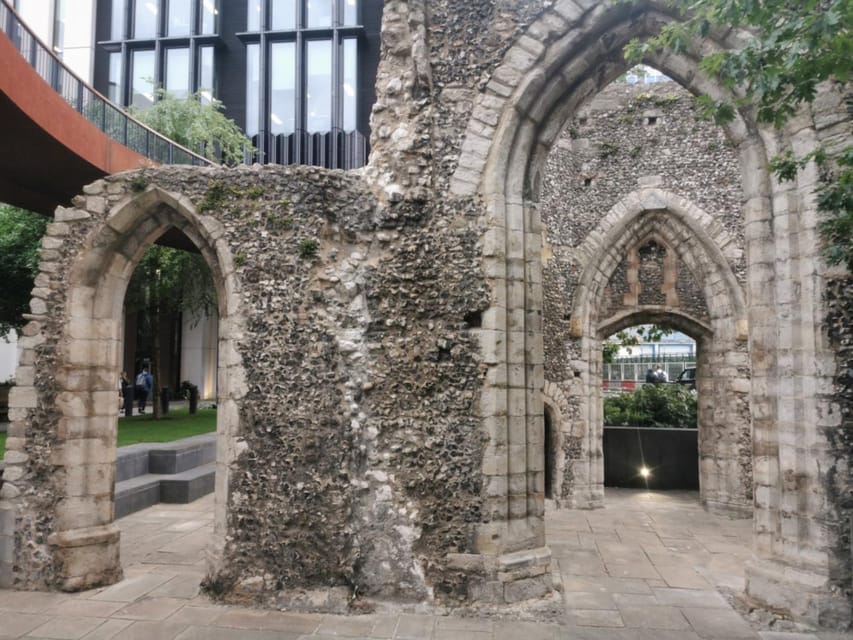
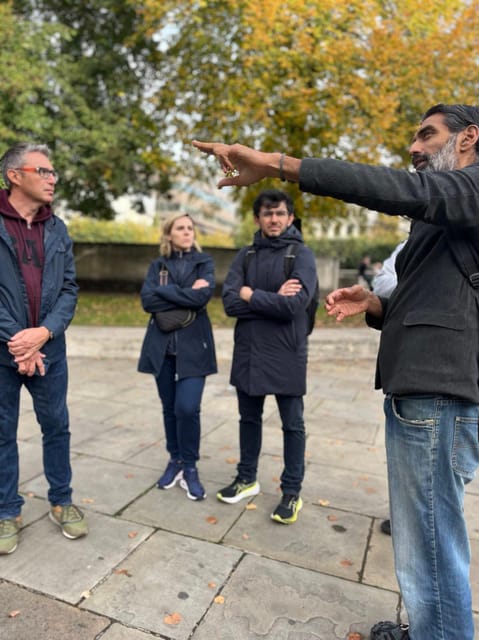
The meeting point is Barbie Green restaurant, opposite the ruins. Look for Arjun, who has longish hair and a beard, plus a felt green dragon on his backpack. That detail is practical and helpful in a busy area where several groups may be gathering.
Starting near the Barbican puts you close to the remains of Roman London. The ruins provide a strong opening because they make the city’s earliest layer visible before the walk moves into streets shaped by later centuries. You begin with the basic question behind the whole tour: why did people choose this location, and how did a settlement become a center of authority and trade?
The first part includes several short guided stops of about 10 to 15 minutes. That format should suit you if you prefer a moving story rather than one long lecture in a single place. It also means you should expect frequent pauses, changes of subject, and a steady amount of walking.
The tour is listed as wheelchair accessible. Still, the practical experience of any historic city walk can depend on the exact route and street conditions, so it is sensible to raise access needs when booking.
Roman, Saxon, Viking, and Norman London
Arjun’s story moves through the peoples who shaped the City over time. The early sections cover Celtic roots, Roman settlement, the Saxons, Vikings, and Normans. This matters because London’s identity was never created by one culture alone.
The Roman period gives you the first major urban framework. Later groups altered, reused, or contested that city rather than simply replacing it in a neat sequence. The Saxons brought new centers of settlement and authority. Viking contact added another layer of conflict and exchange. The Norman Conquest then changed the relationship between the city, the monarchy, and the wider kingdom.
A strength of this part of the walk is the way it connects broad historical shifts to ordinary streets and surviving fragments. You may pass a place that looks unremarkable at first, then hear why it mattered. One of the most useful comments from past participants is that the tour helped make modest-looking sites feel important. That is exactly the value of a good City of London walk.
You should come ready to listen. The route covers many centuries, and the story is not limited to famous names. It also includes the city’s diverse peoples, changing cultures, legends, and quirks. The result is less about memorizing a royal family tree and more about seeing the City as a place repeatedly rebuilt and reinterpreted.
Salters’ Hall and the power of city corporations
Salters’ Hall is one of the named stops. It provides a doorway into the world of London’s livery companies and professional guilds, institutions that helped regulate trades, support members, and shape civic life.
The point is not simply to admire a grand hall. The stop helps explain how organized groups within the City gained authority. London’s corporations were not just business bodies in the modern sense. They were part of the machinery that managed local affairs and protected commercial interests.
This is also where the tour’s title idea becomes clearer: a corporation helped drive the rise of a global empire. The story links local organization, trade, finance, and political influence. You will hear how the City’s institutions became powerful enough to matter far beyond the old walls.
The stop lasts about 10 minutes, so expect interpretation rather than a long interior visit. The appeal lies in the context Arjun supplies. Without that context, a hall or guild building can seem closed off from the rest of London’s story.
More Walking Tours in London
- Magical London: Harry Potter Guided Walking Tour
★ 4.7 · 22,044 reviews - London: The Original Jack the Ripper Walking Tour
★ 4.7 · 7,833 reviews - London: Harry Potter Movies Walking Tour (Kids Go Free)
★ 4.7 · 3,071 reviews - London: The Great British Rock and Roll Music Walking Tour
★ 4.9 · 1,783 reviews
Guildhall and London’s argument with the Crown
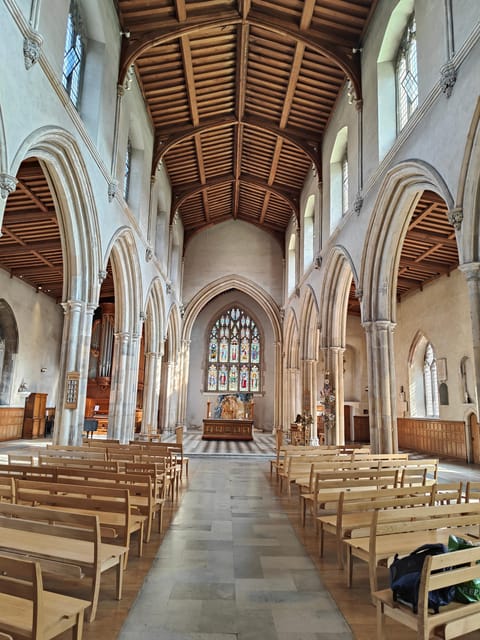
Guildhall receives a longer visit of about 15 minutes. It is one of the route’s key moments because it represents the City’s civic authority and its long relationship with the Crown.
The walk explores how London defied royal authority and became known as the envy of kings. That phrase points to the City’s money, trade, legal privileges, and ability to speak as a corporate body. Monarchs needed London, but London also resisted being treated as just another possession of the Crown.
This tension helps explain the City’s place in the development of English democracy and law. The tour connects London’s local rights with the wider struggle to limit royal power. The Magna Carta forms part of that story, as does the city’s role in protecting legal foundations and civic privileges.
You will not get a full academic seminar on constitutional history in 15 minutes. What you do get is a clear link between streets, institutions, and political change. If you enjoy history that asks how systems work, rather than only who won a battle, Guildhall is likely to be one of the most useful stops.
The dragon emblem and the city’s stubborn identity
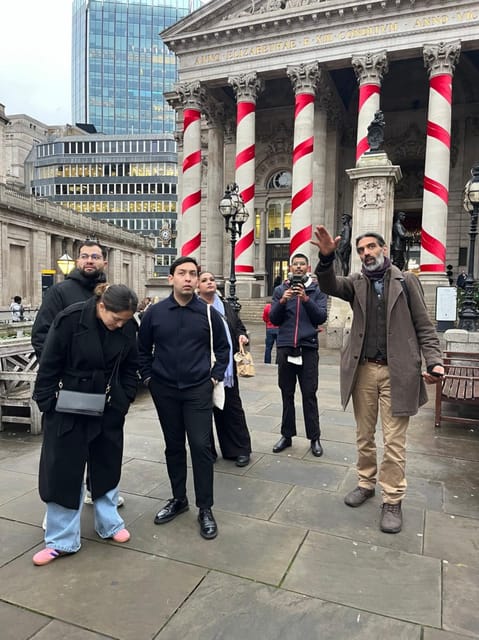
The green dragon on the guide’s backpack is more than a meeting marker. The dragon is the City’s enduring emblem, and the walk explains why it became tied to London’s identity.
A dragon suggests strength, guardianship, and independence. Those ideas fit the City’s long record of defending its rights. The emblem also gives the tour a memorable thread. Instead of treating the history as a pile of disconnected events, Arjun uses the dragon to connect civic pride, resistance, survival, and renewal.
This is one of the more distinctive themes in the experience. You may know the red cross of St George or the royal symbols of England, but the City’s dragon can be less familiar. By the end of the walk, it should feel like a shorthand for the old corporation and its determination to preserve its place.
The tour’s legends matter here too. Arjun is described by past participants as a natural storyteller, and that style seems especially useful for material involving symbols and civic myths. You will hear facts, but the facts are carried by a larger story about a city that refuses to disappear.
Plague, fire, revolution, and the seventeenth-century test
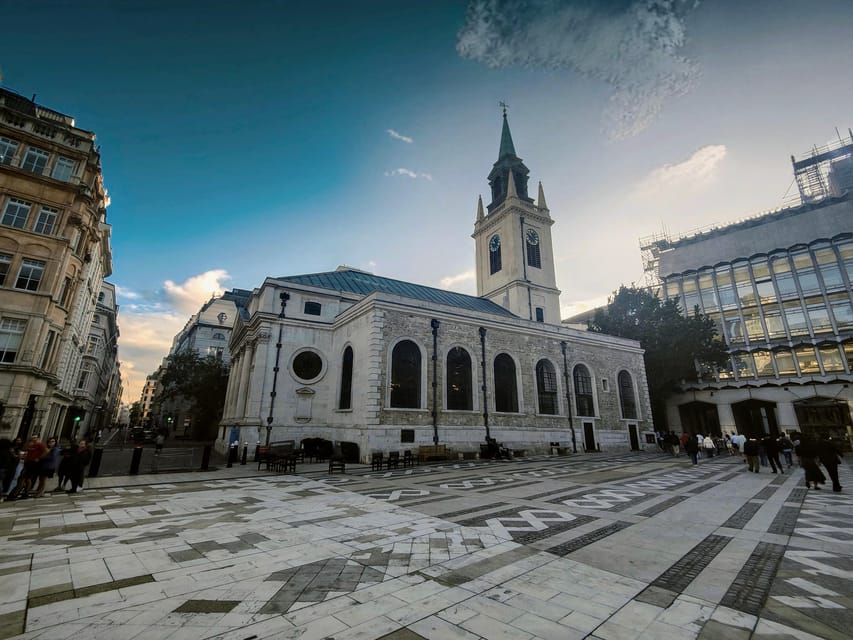
The final historical stretch reaches the close of the turbulent seventeenth century. This brings together plague, the Great Fire, and revolution, three events that changed London’s population, streets, buildings, and political life.
The plague section reminds you that the City’s power came with serious risk. Dense urban life supported trade and wealth, but it also made disease devastating. The Great Fire then destroyed much of the medieval city, forcing London to rebuild and reconsider its streets, structures, and civic priorities.
The tour does not end with disaster. Its central image is a phoenix, a city rising again after destruction. That idea leads into the story of how London secured its rights and privileges for later generations.
Revolution adds the political charge. By the end of the seventeenth century, the relationship between monarch and Parliament had changed dramatically. The City’s earlier resistance to royal authority now fits into a larger national argument about power, law, and representation.
These events give the final third of the walk emotional weight. You see the City not as a preserved museum piece, but as a place that has survived repeated shocks by adapting.
Royal Exchange, Mansion House, and the financial City
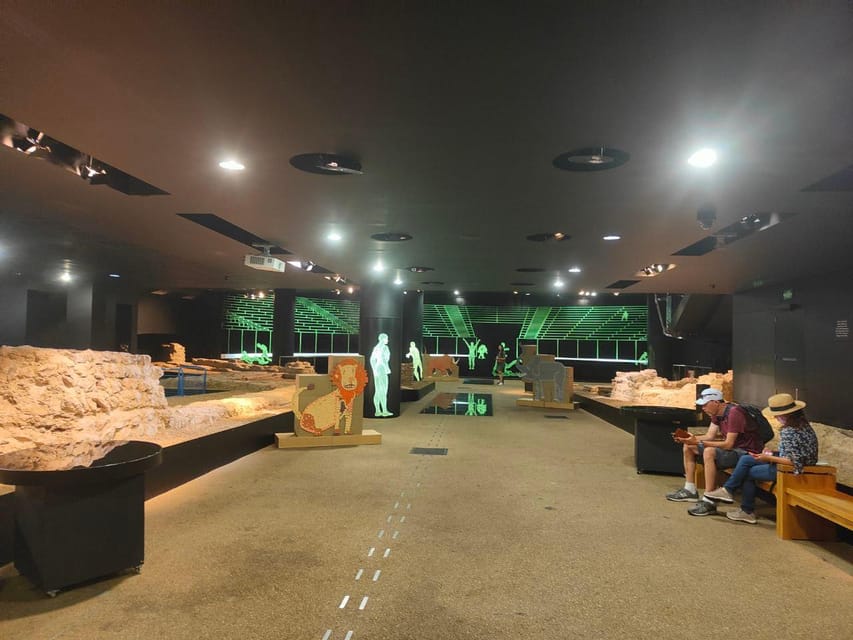
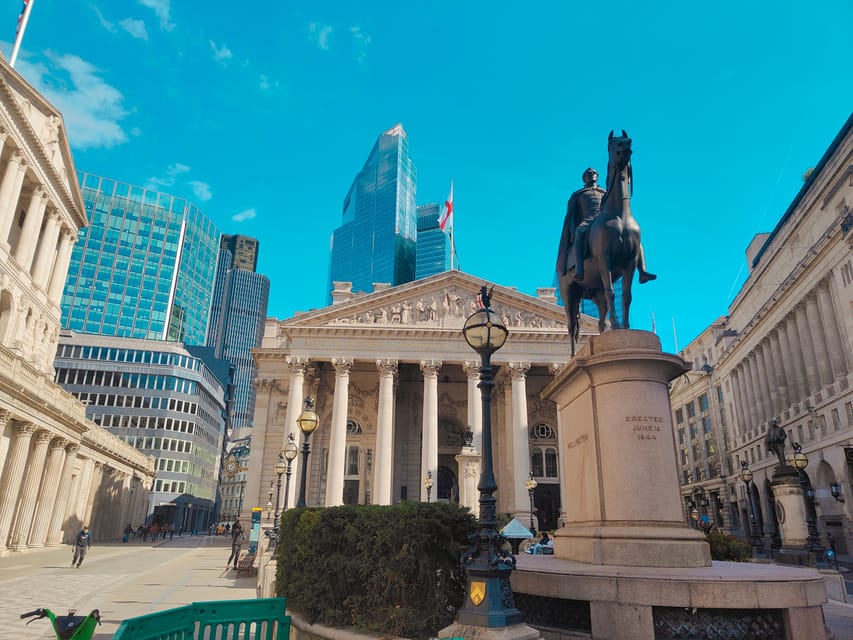
The Royal Exchange appears late in the route, followed by Mansion House. These stops shift the focus from medieval civic rights to commerce and finance.
The Royal Exchange helps explain how London’s trading ambitions grew. It represents a city increasingly connected to markets, merchants, and international business. That connection is part of the tour’s larger claim that a corporation born in the City helped drive the expansion of a global empire.
Mansion House brings you closer to the City’s civic leadership. It is linked to the Lord Mayor and the continuing identity of the City as a distinct corporation within Greater London. You can see how the old civic structure remained visible even as London became a much larger capital.
Each stop is short, about five minutes. That is enough for a sharp explanation and a look at the setting, but not enough for a detailed interior tour. Keep your expectations aligned: this is a guided historical walk, not a series of building visits.
Still, the sequence works well. You move from ancient settlement to political authority, then to organized trade and finance. It shows how the City’s influence changed form without vanishing.
Finishing at the Bank of England
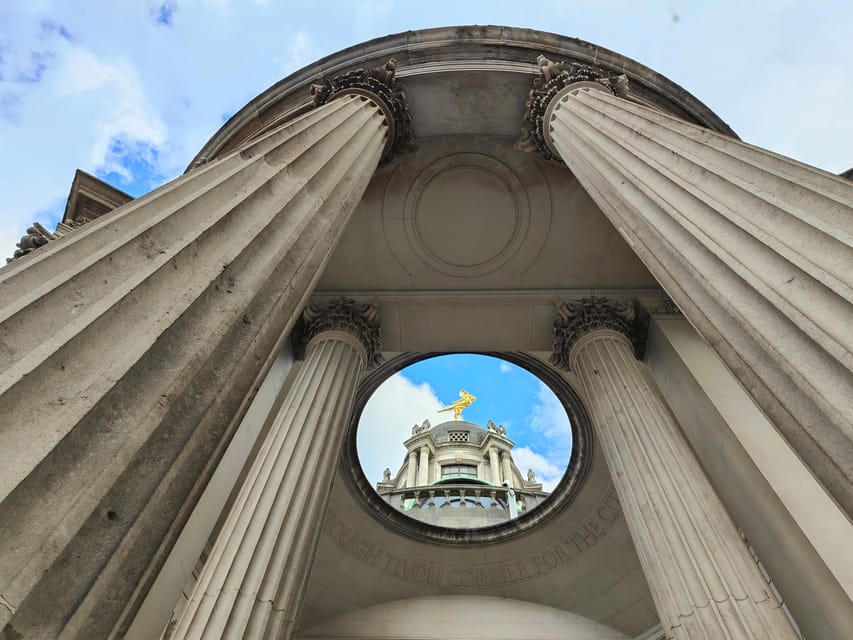
The walk ends at the Bank of England. This is a fitting final point because it brings the story into the financial world most closely associated with the City today.
The Bank is not presented as an isolated attraction. It is the endpoint of a long chain that begins with settlement, civic rights, guild organization, merchant power, royal negotiation, and international trade. You finish with a clearer idea of why this small district has such influence.
Ending here also makes the tour easy to connect with the rest of your day. You can continue exploring the City, walk toward nearby central London sights, or use the financial district as a new reference point. The experience gives you historical bearings before you continue on your own.
How the timing and group size affect the experience
The full duration is 2.5 hours, with roughly 15 guided stops. Some sections last five minutes, while key places such as Guildhall receive 15 minutes and one part of the route receives about 25 minutes.
That structure means the walk is tightly organized. You will cover a lot of ground, but the route should not feel like an exhausting march because the stops break up the movement. Wear comfortable shoes and allow for London weather. One participant found the tour worthwhile even on a cold, gray day, though rain can make any outdoor walk less pleasant.
The group limit of eight is a real advantage. Arjun can speak to the whole group without shouting, and you can ask questions as the story develops. Small groups also make it easier to notice the ordinary-looking details that the tour is built around.
The walk is listed at $30 per person. I consider that fair for a 2.5-hour guided experience with a specialist focus, especially if you have already seen the Tower, Westminster, and the major royal sights. You are paying for interpretation and access to a connected story, not for admissions or food.
No food is served, so eat beforehand if you need a proper meal. The meeting point at Barbie Green may be convenient for a drink or snack, but food is not part of the tour itself.
Who will get the most from this walk
I would choose this tour if you have visited London before and want something beyond the usual landmarks. It also works well for first-time visitors who enjoy political history, urban development, trade, and local institutions more than photo stops.
You will get the most from it if you enjoy listening and asking questions. The amount of information is substantial, and the tour’s appeal comes from the way separate periods connect. If you want a relaxed walk with long breaks, shopping time, or extensive access inside buildings, this may not be the best fit.
The small group makes it suitable for solo visitors, couples, and families with older children who can handle a history-heavy walk. The activity is wheelchair accessible, and you can ask about language needs in advance. The live tour is in English, while multilingual arrangements are stated as possible if requested ahead of time.
The strongest reason to book is Arjun’s storytelling approach. He brings contemporary and historical settings together, which helps the City feel like a living district rather than a set of ruins. His friendly, conversational style also suits a small group where discussion is part of the experience.
Should you book the City of London Historical Walking Tour?
Book it if you want to understand why the City of London is different from Westminster, how merchants and corporations challenged royal power, and how plague, fire, and revolution reshaped the old center.
The tour is especially good value for repeat London visitors, history-minded walkers, and anyone who prefers overlooked places to famous queues. At $30, it offers a focused half-day experience with a clear theme and a very small group.
Skip it if your priority is entering major attractions, eating during the tour, or seeing only the most recognizable London sights. For everyone else, this is a smart way to give the City of London a story, a symbol, and a political identity.
FAQ
How long is the City of London Historical Walking Tour?
The tour lasts 2.5 hours.
How much does the tour cost?
The price is $30 per person.
Where does the tour begin?
The meeting point is Barbie Green restaurant, opposite the ruins.
How will I recognize the guide?
The guide is Arjun. You can identify him by his longish hair and beard, and by the felt green dragon on his backpack.
Where does the tour finish?
The walk finishes at the Bank of England.
Is the tour wheelchair accessible?
Yes, the activity is listed as wheelchair accessible.
What language is used on the tour?
The live tour guide is in English. Multilingual support is available by advance request, so you should state your language ahead of time.
New listings around London
- London: Bermondsey Craft Brewery Tour★ 5.0 · 3 reviews
- Colourful Notting Hill Photography Tour★ 5.0 · 3 reviews
- The London Historic Pubs Tour★ 4.0 · 3 reviews
- Ultimate Royal London, Thames River Boat Ride & Walking Tour★ 5.0 · 3 reviews
- London: Wallace Collection & National Gallery Private Tours★ 5.0 · 3 reviews
- London: The Birthplace of The Rolling Stones Private Tour★ 5.0 · 3 reviews
- Historic pub tour with Brazilian guide (in Portuguese)★ 5.0 · 3 reviews
- London: Royal Tour with Westminster Abbey & Afternoon Tea★ 3.0 · 3 reviews
London Tours, compared.

Westminster to Greenwich River Thames Cruise
Read our review →
Magical London: Harry Potter Guided Walking Tour
Read our review →


Warner Bros. Studio Harry Potter Tour with Transfers
Read our review →Browse the lists this tour appears in