
Reviewed · BIRMINGHAM TOURS
Birmingham: Discovering Birmingham Guided Walking Tour
Birmingham’s story makes the most sense on foot, where old canals, jewellery workshops, Victorian industry and post-war rebuilding sit close together. This two-hour walk links those pieces in a clear route from the Library of Birmingham, along the canal system, through the Jewellery Quarter, and back to St Philip’s Cathedral.
I like the canal-side route, which gives the tour a strong sense of place rather than turning into a string of dates and names. I also like the guidebook and audio receiver, practical touches that help you follow the live commentary. The main consideration is pace: 3 kilometres in two hours is easy for most people, but you will be walking and listening throughout, with comfortable shoes essential.
Key points at a glance
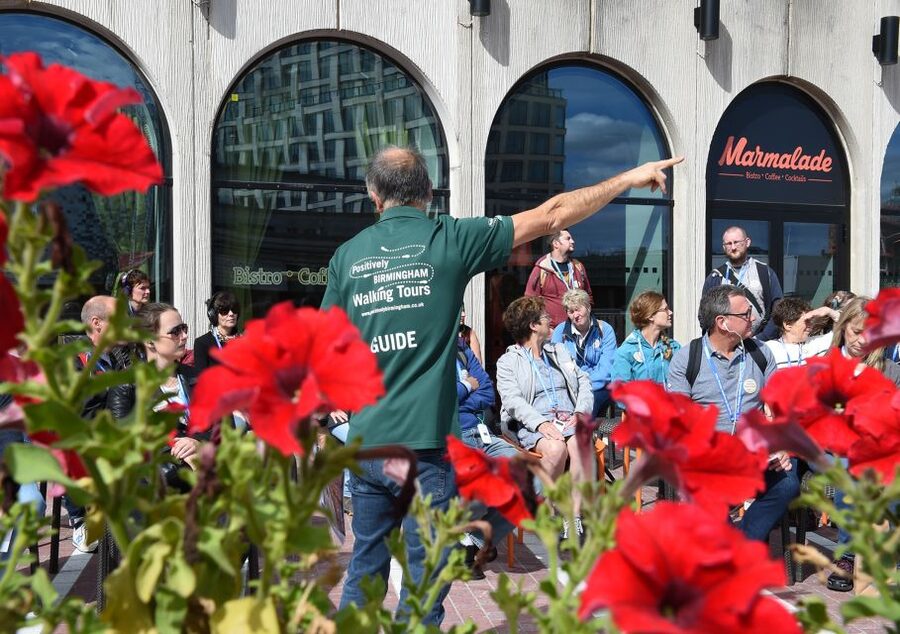
- The route covers about 3 kilometres in two hours, making it a useful first look at central Birmingham.
- The canal system provides the opening chapter, showing how water helped Birmingham’s industry grow.
- The secret canal leads toward the Jewellery Quarter, where Georgian and Victorian enterprise changed the city.
- Jonathan’s lively guiding style combines facts, surprises and light humour rather than a dry lecture.
- Post-war redevelopment gets an honest look, including the serious problems caused by some planning decisions.
- St Philip’s Cathedral and its churchyard finish the walk with architecture and a reminder of the human cost of industrial growth.
Starting beside the Library of Birmingham
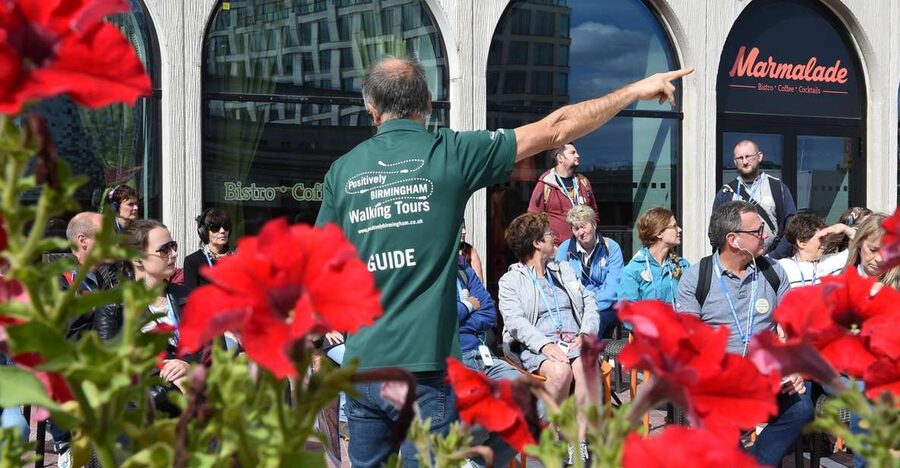
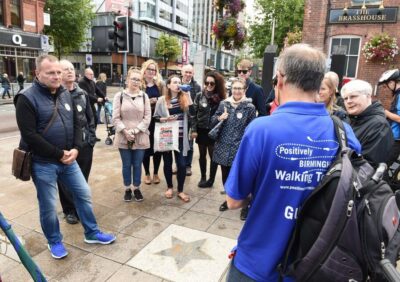
You meet at the front entrance of the Library of Birmingham, normally beside a pop-up stand. This is a sensible starting point because the library sits in the city centre and is easy to identify, though you should allow enough time to find the entrance rather than arriving at the last second.
The opening section sets up the main idea of the walk: Birmingham did not become an important industrial city by accident. Its modern working life grew from older systems of trade, transport, invention and production. The guide connects those systems to the streets you are walking through, so the city begins to feel less like a collection of separate sights.
You are given an audio receiver so the guide’s live commentary can be heard clearly by everyone. Bring earphones with a standard 3.5 mm jack. If you do not have them, you can receive a pair in exchange for a small donation to a charity supporting homelessness in Birmingham.
That audio setup is worth noting. A canal path or busy city centre can make ordinary guiding hard to hear, especially if the group spreads out. Here, you can keep walking without having to crowd around the guide.
More Walking Tours in Britain:
- Magical London: Harry Potter Guided Walking Tour
★ 4.7 · 22,044 reviews - London: The Original Jack the Ripper Walking Tour
★ 4.7 · 7,833 reviews - Oxford: University and City Walking Tour with Alumni Guide
★ 4.7 · 4,429 reviews
Following Birmingham’s original canal system
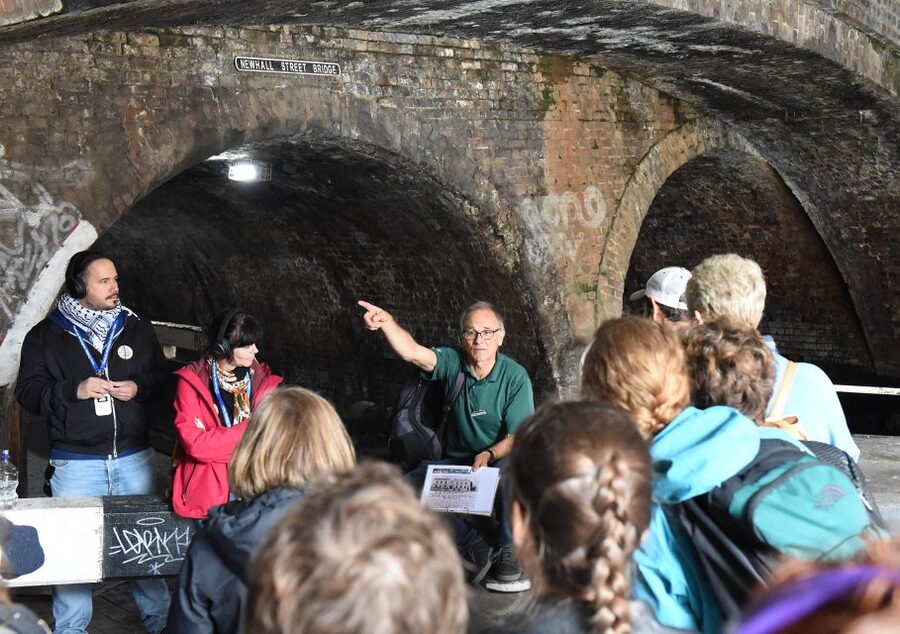
The first major theme is water. Birmingham’s canals were not built simply to make the city attractive. They were working routes that helped move goods and materials during the city’s industrial growth.
The tour explains the origins of the original canal and shows how the canal system shaped Birmingham’s development. This is useful context because the city’s industrial success depended on more than clever inventions. Those ideas needed transport, workshops, investment and access to wider markets.
I find this part especially helpful if you are new to Birmingham. It gives you a practical way to understand the city: look for the links between movement, work and production. The canal becomes a piece of infrastructure with a human purpose, not just a pleasant waterside path.
The route then uses what is described as the secret canal toward the Jewellery Quarter. That change in setting gives the walk some atmosphere and variety. You leave the broad idea of Birmingham’s canal network and move toward the district that became one of the city’s major industrial centres.
Do not expect a long canal cruise or a full study of every waterway. This is a walking tour, and the canals are one important chapter in a wider story. The value comes from seeing how they connect to the buildings and working districts nearby.
Entering the Jewellery Quarter through Georgian industry
The Jewellery Quarter developed as a major centre of Birmingham’s Industrial Revolution, with roots reaching back to Georgian times. The tour uses the area to show how small-scale ideas could turn into organised production.
That shift is one of the strongest parts of the experience. You learn about inventors and entrepreneurs who seized opportunities and moved from an idea to factory production in a surprisingly short time. The point is not just that Birmingham had factories. It is that the city created a working culture where invention, business and manufacturing fed one another.
The Jewellery Quarter also gives the guide plenty of room to point out surprises along the way. The supplied details do not list each surprise, so you should not book this expecting a fixed catalogue of secret stops. Instead, think of them as small discoveries that break up the main historical thread.
This district is a good fit for you if you prefer history that can be seen in the shape of a neighbourhood. The walk does not treat the Industrial Revolution as something that happened far away in a textbook. It shows how an area developed around work and how that role continues to matter.
At the same time, the Quarter is not presented as a preserved museum. You see its role in the modern city as well as its industrial past. That matters because Birmingham’s old working districts are not frozen in one period. The tour asks you to look at what remains, what has changed and how the Quarter fits into the city today.
From Victorian invention to factory production
The Victorian section expands the story. Georgian beginnings led into a period when inventive ideas could be turned into large-scale production with remarkable speed.
The guide’s job here is to explain the connection between individual initiative and the wider systems that made mass production possible. That is more useful than a simple list of famous Birmingham products or local personalities. You get a clearer sense of how the city worked as an industrial machine.
This is also where a strong guide makes a difference. Jonathan is singled out by name in the available feedback, and his approach is described as enthusiastic, factual, light-hearted and interactive. That mix suits a subject that can become technical or overloaded with dates.
You should expect a talk with energy rather than a silent architectural walk. The guide clearly knows the subject and takes pride in Birmingham, but the best reason to book is the way the information is delivered. Several comments praise Jonathan’s dedication, passion and ability to provide context that a first walk around the city would not give you.
The audio receiver lets you keep your eyes on the streets rather than constantly turning back toward the guide. You will still need to pay attention to the walking route, but the setup makes it easier to absorb the explanation while moving.
A handful of other Britain outings to weigh up
- Birmingham: Cadbury World Entry Ticket
★ 4.4 · 230 reviews - Birmingham: Slogging Gangs Guided Walking Tour
★ 4.2 · 216 reviews - From Birmingham: Cotswolds Full-Day Tour
★ 4.7 · 215 reviews - Birmingham: Winterbourne House and Garden Admission Ticket
★ 4.7 · 199 reviews
Looking honestly at post-war redevelopment
The tour does not stop with Birmingham’s industrial success. It turns to post-war redevelopment and the serious issues caused by the way parts of the city were rebuilt.
This is an important choice. Many city walks focus on attractive old buildings and present redevelopment as simple progress. Here, you are shown the contrast between older urban fabric and a more modern city shaped by post-war decisions. The result is a more useful explanation of Birmingham today, including the problems that followed some attempts to modernise it.
The walk also explains how Birmingham is rejuvenating itself as a modern world city. That does not mean pretending every change has been successful. Instead, you get a view of a city still working out how to renew itself while living with the results of earlier choices.
For me, this is what gives the tour more weight than a standard introduction. You are not only shown what is attractive. You are encouraged to ask why the city looks as it does, who benefited from redevelopment and what was lost along the way.
There is a trade-off. If you want a tour devoted only to historic buildings and cheerful local stories, this section may feel more serious. If you want Birmingham explained as a living city, the honest treatment of redevelopment is a strong reason to choose this walk.
St Philip’s Cathedral and the city’s difficult past
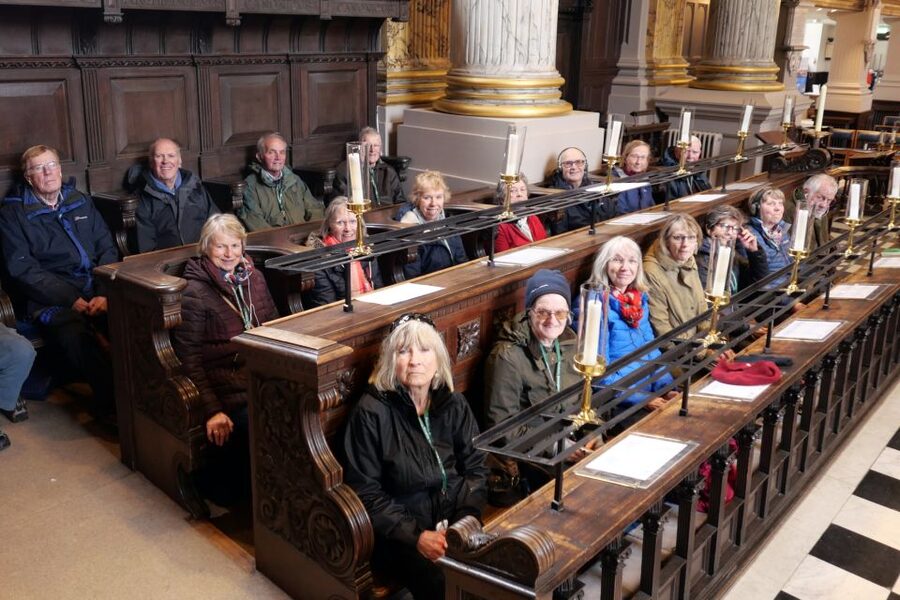
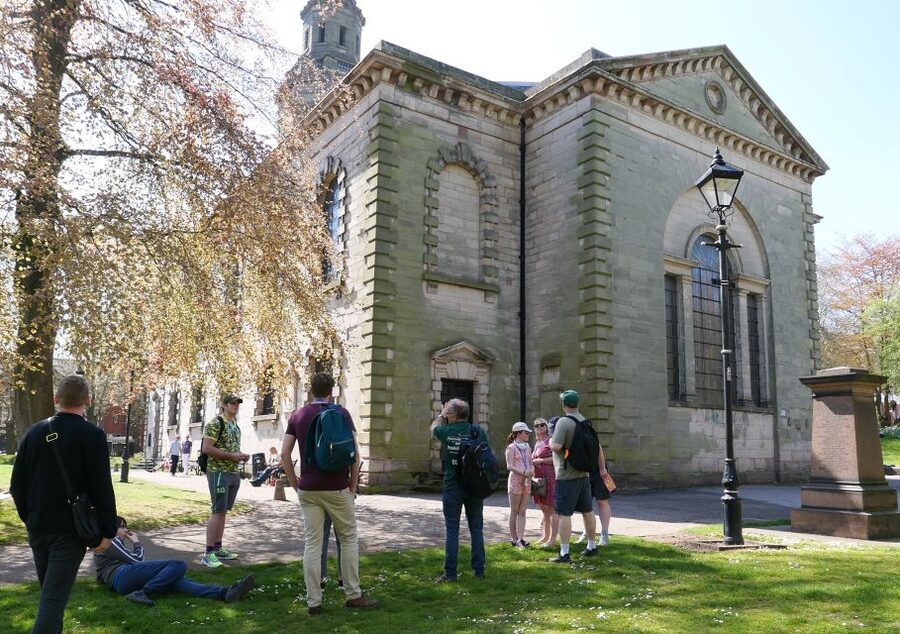
Back in the city centre, the route reaches St Philip’s Cathedral. Its English Baroque architecture provides a change of mood after the industrial and planning stories.
The cathedral is more than a final photo stop. Its churchyard contains clues to the difficult issues Birmingham faced as it grew into what was once called the workshop of the world. The tour uses this setting to connect grand architecture with the pressures created by rapid industrial growth.
That contrast works well. You move from canals and production to a church and its surrounding burial ground, but the themes remain connected. Birmingham’s wealth, working life and social problems all developed together.
The cathedral also gives the walk a clear ending point in the centre. You finish with one of Birmingham’s most important historic buildings rather than simply stopping on an anonymous street. The architecture offers a visual reward, while the churchyard adds a quieter and more reflective note.
Do not expect a full cathedral tour or a detailed architectural survey. The cathedral is one part of a wider route, and the main goal is to use it to explain Birmingham’s past and present.
What Jonathan’s guiding style adds
A city walk lives or dies by its guide. The route itself is worthwhile, but canals and old industrial districts do not explain themselves.
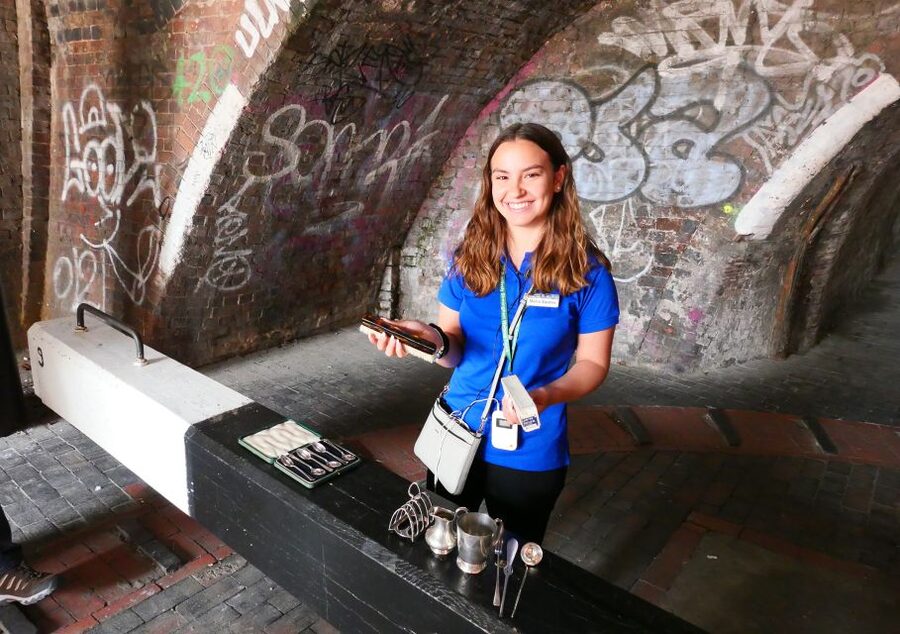
Jonathan receives especially strong praise for his subject knowledge, enthusiasm and delivery. One person who took the walk on a first visit to Birmingham found it gave the city the context missing from an earlier unplanned walk. That is exactly where this experience has its greatest value: it turns scattered impressions into a connected story.
The style appears to balance detail with humour. You can expect plenty of facts, but not a heavy academic lecture. The tour is described as interactive and motivating, with surprises along the way. That makes it suitable for curious first-time visitors and for local people who want to understand familiar streets better.
The guidebook is another useful touch. It gives you something to keep after the walk, and one recent participant specifically appreciated receiving it. I would treat it as a companion rather than a replacement for the live tour. The main value is still the guide’s explanation at each stop.
The 4.9 rating from 26 reviews suggests a very consistent experience, though the sample is not huge. One four-star assessment still described the tour as very interesting and praised the guide’s clear expertise and passion. That small range is reassuring: the experience seems strong, while personal taste about pace and subject matter can still affect your score.
Is $20 good value for two hours?
At $20 per person, this is fairly priced for a focused two-hour guided walk, especially because the fee includes the audio receiver and a tourist guidebook.
The value is not in the number of major attractions you enter. You are not paying for admission to a series of museums or for a long list of interiors. You are paying for interpretation, route planning and the chance to understand how Birmingham’s canals, industrial districts, redevelopment and cathedral relate to one another.
That makes the tour most useful at the start of your visit. Take it early, and you will have a stronger frame for exploring the city on your own afterward. You may also decide which parts of the Jewellery Quarter or centre deserve a second look.
The reserve-now-and-pay-later option keeps your plans flexible, and cancellation is free up to 24 hours before the start for a full refund. Starting times vary, so you need to check availability when booking.
Who should book this Birmingham walk?
I would recommend it to first-time visitors who want context quickly without spending half a day in a museum. The 3-kilometre route covers enough ground to give you a real feel for Birmingham, but the two-hour duration leaves room for your own plans afterward.
It is also a good choice for anyone interested in industrial history, canals, urban planning or the way old working districts change over time. The walk does not avoid difficult subjects, so it suits you if you prefer an honest city story to a simple parade of highlights.
Families with older children may enjoy the surprises and practical stories about inventions and production, though the tour still asks for steady attention. Comfortable shoes are a must, and you should be happy walking and listening for the full two hours.
You may want a different activity if you need step-free details, a tour in another language or a purely architectural experience. This walk is in English, and the supplied information does not provide accessibility details or a breakdown of every surface and incline. It is best to confirm any specific mobility needs before booking.
Should you book Discovering Birmingham?
Book this tour if you want Birmingham explained rather than merely displayed. The combination of canals, the secret route into the Jewellery Quarter, Georgian and Victorian industry, post-war redevelopment and St Philip’s Cathedral gives you a well-shaped introduction to the city.
The strongest reason to choose it is Jonathan’s reported guiding style: informed, passionate, clear and light-hearted. The main drawback is that the walk covers serious and sometimes complex subjects in only two hours, so you will get a well-chosen overview rather than every detail.
At $20, with a guidebook and audio receiver included, it offers good value for a first day in Birmingham. Bring comfortable shoes and 3.5 mm earphones, meet at the Library of Birmingham, and you will be ready for a useful, thoughtful walk through a city that rewards a closer look.
FAQ
Where does the Birmingham walking tour meet?
The meeting point is at the front entrance of the Library of Birmingham. There is normally a pop-up stand nearby.
How long is the tour?
The tour lasts two hours.
How far will I walk?
The total distance is about 3 kilometres, or 2 miles, over the two-hour walk.
What language is the tour conducted in?
The live guided tour is conducted in English.
Who leads the tour?
Jonathan is identified as the guide associated with the experience. His guiding is described as factual, passionate, interactive and light-hearted.
What should I bring?
Bring comfortable shoes and earphones with a 3.5 mm jack so you can use the audio receiver.
What if I do not have suitable earphones?
You can receive earphones in exchange for a small donation to a charity supporting homelessness in the city.
Is a guidebook included?
Yes. A tourist guidebook is included with the experience.
Can I cancel the booking?
Yes. You can cancel up to 24 hours in advance for a full refund. You can also reserve now and pay later.
New listings around Britain
- London: Secrets of Freddie Mercury Tour with a Cocktail★ 4.1 · 15 reviews
- London: Hampton Court Private Guided Tour★ 3.4 · 15 reviews
- Edinburgh: Isle of Skye, Highlands & Jacobite Steam Train★ 4.6 · 15 reviews
- London: Jack the Ripper Tour and Underground Prison in Spanish★ 5.0 · 15 reviews
- Spanish Language : Original Harry Potter Walking Tour★ 4.5 · 15 reviews
- THE HANGOVER BRUNCH | Benidorm Bingo & Drag Queens★ 4.5 · 15 reviews
- London: Private Couples Photography Session with Landmarks★ 5.0 · 15 reviews
- London: The Saturday Supershow Cabaret at Phoenix Arts Club★ 4.5 · 15 reviews
Birmingham Tours, compared.



Guided City Center Walking Tour (10:30am & 2pm)
Read our review →
Browse the lists this tour appears in